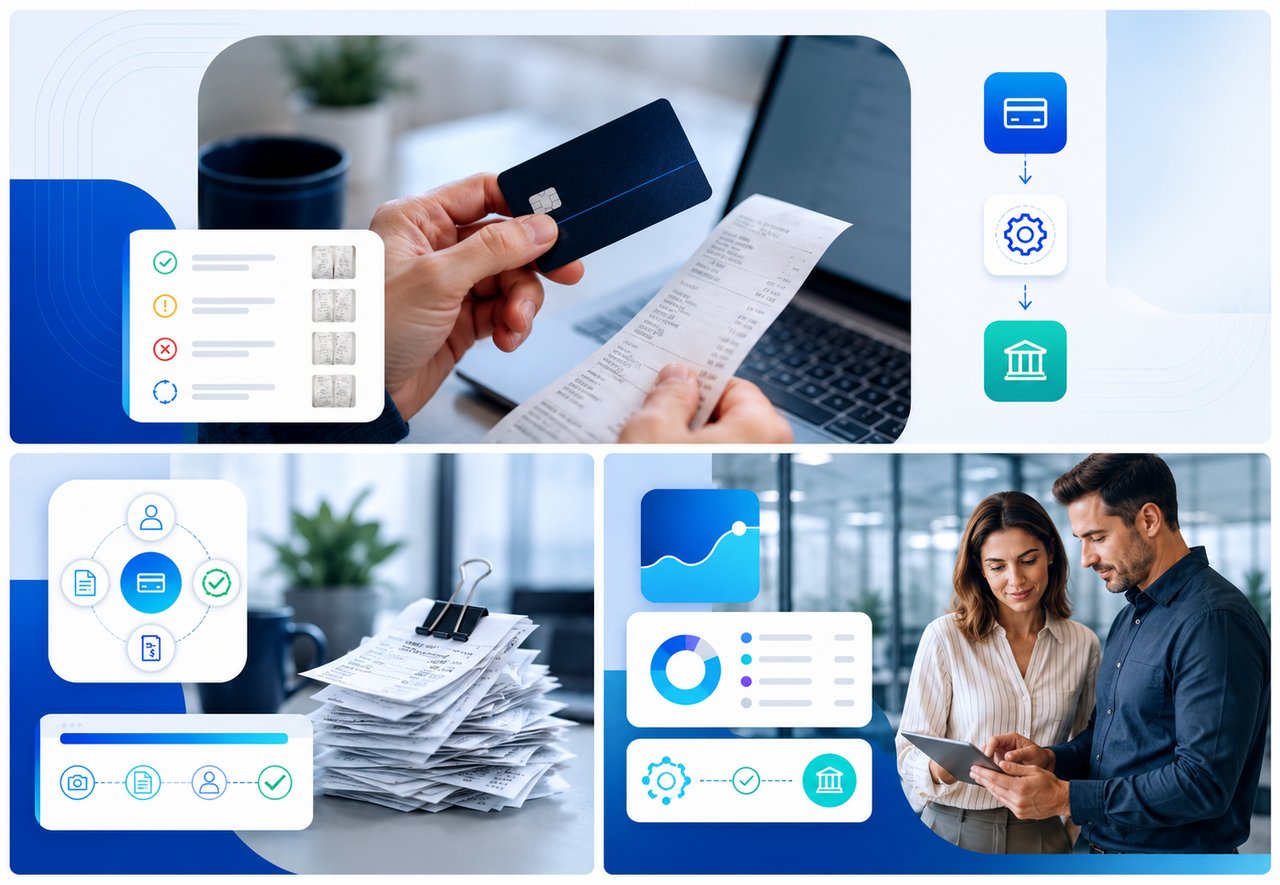


Many Sage Intacct customers assume that because corporate card payments are ultimately made through Cash Management, that's where reconciliation should happen.
This misconception is understandable. Most ERP systems are designed around accounting events, so it's easy to assume that transaction reconciliation should happen in the same place. The accounting belongs in Sage Intacct. However, finance teams spend considerably more time managing receipts, coding, approvals, exceptions, and employee follow-up than they do posting accounting entries. The operational management of corporate card transactions is far more effective when it happens in DATABASICS.
Our philosophy is simple:
Manage transactions where the work happens.
Account for them where the books are maintained.
Why should Sage Intacct customers reconcile corporate cards in DATABASICS?
 The biggest advantage of DATABASICS is that reconciliation becomes a continuous process instead of a month-end event.
Continuous reconciliation means resolving receipts, coding, ownership, and exceptions throughout the month instead of waiting until the statement arrives.
This means you can:
- assign transactions immediately
- collect receipts immediately
- chase missing documentation while the expense is still fresh
- monitor aging
- resolve exceptions throughout the month
- dramatically reduce month-end workload
Better control over the entire transaction lifecycle
Managing transactions in DATABASICS provides capabilities that extend beyond what is available through a standard Cash Management workflow.
These include:
- Earlier visibility - Transactions are available within a day of purchase, allowing reconciliation to begin immediately.
- Better ownership - Ghost card transactions can automatically be routed to the correct employee instead of being manually reassigned.
- Cleaner compliance - Receipts stay attached to individual transactions; validations are enforced near real time.
- Flexible statement management - End users can report expenses by trip / event, but you can still track individual transactions to the appropriate statement.
- Complete audit trail - Capturing every action taken throughout the reconciliation process.
- Support for accrual accounting - Unreconciled transactions can be included in accrual postings when required.
Rather than simply reconciling a statement, DATABASICS provides an end-to-end workflow for managing corporate card transactions. For organizations that require receipts and supporting documentation to remain visible within Sage Intacct, DATABASICS can post transactions at the document level, preserving the relationship between the accounting entry and the underlying expense evidence.
 A cleaner accounting process in Sage Intacct
Finance teams sometimes worry that reconciling outside Cash Management will complicate the accounting. In practice, the opposite is true. By posting approved transactions directly to the expense accounts with an offset to Credit Card Payables, the accounting entries are fully balanced and Sage Intacct avoids duplicate accounting activity while maintaining a clear liability that is settled when the card statement is paid.
This approach allows you to pay the statement when it is due, or when it suits you, and removes unnecessary manual processing while eliminating duplicate data handling between systems.
How does DATABASICS post corporate card transactions to Sage Intacct?
Whether we post credit card transactions to AP Bills, Expense Report, Journal Entry or Cash Management depends on your accounting preferences, not on how reconciliation is managed. DATABASICS supports each of these approaches while maintaining the same operational workflow.
Our recommendation
Corporate card reconciliation is fundamentally an operational process, not simply an accounting process.
DATABASICS manages that operational workflow from the moment a transaction is received directly from the card provider, through approval, receipt collection, reporting, and reconciliation. Sage Intacct records accurate accounting entries and supports financial reporting regardless of the desired integration target.
By separating operational management from financial accounting, organizations gain earlier visibility, stronger controls, faster month-end close, and a significantly better user experience for both employees and finance teams.
Frequently Asked Questions
Does DATABASICS replace Sage Intacct Cash Management?
No. DATABASICS manages the operational work of collecting receipts, coding transactions, routing approvals, and resolving exceptions. Sage Intacct remains the accounting system, and Cash Management continues to support credit card account reconciliation and payment.
Can receipts remain visible in Sage Intacct?
Yes. When supporting documentation needs to remain visible in Sage Intacct, DATABASICS can post transactions at the document level. Exact document handling depends on the organization's integration configuration.
Which Sage Intacct posting target should we use?
The right target depends on your accounting preferences and Sage Intacct configuration. DATABASICS can support AP Bills, Expense Report, Journal Entry, or Cash Management while preserving the same operational workflow.

Unify Timesheets and Expenses to Speed Project Billing
Read Now
Evaluating NetSuite? Five Timesheet and Expense Reporting Questions to Ask...
Read Now
7 Questions to Ask a Dynamics Timesheet & Expense Reporting Vendor at Community...
Read Now
Mexico's 2027 workweek changes: what U.S. companies should review in their...
Read Now
AI Spending is Creating a New Spend Visibility Problem
Read Now
2027 GSA Per Diem and IRS Mileage Rates: Travel Reimbursement Guide (Updated...
Read Now