As we approach the close of the year, it is the perfect time for organizations using Time and Expense to make sure their systems are configured correctly for a smooth transition into 2026. Whether you manage timesheets, leave balances, mileage, per diem rates, or expense compliance, proper preparation now will help prevent surprises later.
This year's checklist also includes an important update: the new overtime tax deduction under the One Big Beautiful Bill Act, which introduces federal tax benefits for employees and new reporting requirements for employers starting in 2026.
Here is everything you need to review before year-end.
1. Set Up Holidays for 2025 and 2026
Holiday schedules are essential for accurate timesheet validations and ensuring that non-working days are properly reflected across your organization.
What to Do:
-
Review or create your holiday calendars for 2025 and 2026.
-
Assign calendars to the correct locations.
-
Confirm that holiday rules align with internal policies.
Correct setup reduces year-end adjustments and supports clean timesheet data from day one.
2. Skip Scheduled Jobs on Holiday Dates
Many organizations prefer to avoid sending system reminders such as missing timesheet alerts, extract jobs, or credit card reminders on company-wide holidays.
What to Do:
-
Add holiday dates such as December 23 to your Skip Job Schedule.
-
Select which reminder or batch jobs should be paused.
-
Resume standard schedules after the holiday period.
This ensures that employees are not receiving unnecessary messages while out of office.
3. Review PTO and Leave Balance Carryover
For organizations using the PTO or Leave Management module, now is the time to verify that all carryover rules match your 2026 leave policies.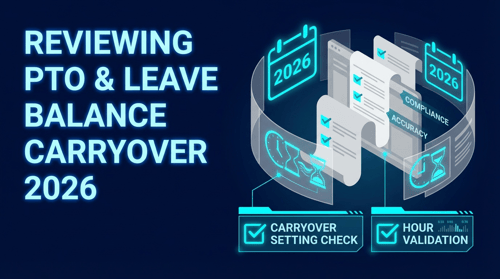
What to Do:
-
Review each Leave Method's carryover settings.
-
Validate the maximum hours allowed to carry over.
-
Confirm expiration rules for carried-over hours.
-
Run leave balance reports to ensure everything matches your expectations.
Keep in mind: Leave Method changes apply only to future periods, and they do not retroactively update prior transactions.
4. Update Mileage Rates for 2026
Mileage reimbursement rates often change annually, especially IRS-standard mileage rates for business travel. The IRS typically announces the following year's rates in December.
What to Do:
-
Review your mileage categories and confirm compliance with IRS or internal standards.
-
Monitor for the announcement of 2026 IRS mileage rates (the 2025 rate is 70 cents per mile).
-
Update mileage rates for 2026 once announced.
-
Notify employees of rate changes before the start of the year.
This ensures accurate reimbursement and consistent audit compliance.
5. Refresh Per Diem Rates
 If your organization uses per diem allowances, ensure your system reflects the most recent GSA domestic and State Department international rates.
What to Do:
-
Update lodging, M&IE (Meals and Incidental Expenses), and total per diem rates for 2026.
-
Validate that region mappings are accurate.
-
Confirm that the first- and last-day rules are applied correctly.
With updated per diem tables, your travel reimbursements will stay aligned with federal guidance and internal policy.
6. Review Travel Policy Rules
Year-end is the perfect time to ensure your organization's travel policy is properly reflected within your Expense system.
What to Do:
-
Review reimbursement limits, receipt requirements, and rules around airline, hotel, and car rental expenses.
-
Confirm that approval routing matches your latest workflow.
-
Update on-screen messaging or policy guidance for your employees.
A refreshed travel policy improves compliance and increases employee confidence in the system.
7. Important for 2025-2026: The New Overtime Tax Deduction (One Big Beautiful Bill Act)
A significant update for payroll and timekeeping is the introduction of a federal income tax deduction for qualified overtime pay earned during 2025-2028 under the One Big Beautiful Bill Act (Public Law 119-21, signed July 4, 2025).
This creates meaningful tax benefits for employees, with new reporting requirements for employers beginning in 2026.
What Employers Need to Know
The Tax Benefit:
-
Employees can deduct up to $12,500 ($25,000 for joint filers) in qualified overtime compensation from their federal taxable income
-
The deduction applies to the overtime premium portion, typically the "half" of "time-and-a-half" pay required by the Fair Labor Standards Act (FLSA)
-
The deduction phases out for taxpayers with modified adjusted gross income over $150,000 ($300,000 for joint filers)
-
This benefit applies to tax years 2025 through 2028
Important: Social Security, Medicare, and state and local taxes still apply to all overtime compensation. Only federal income tax is affected.
2025 Transition Year: Optional Reporting
For tax year 2025, the IRS is providing transition relief:
-
Employers are encouraged but not required to separately report qualified overtime compensation
-
The IRS has granted penalty relief for employers who cannot provide separate accounting for 2025
-
If you choose to provide this information to employees for 2025, you may use:
-
Box 14 on Form W-2
-
A separate written statement
-
An online employee portal
-
Year-end pay stubs showing overtime premium breakdowns
-
Employees can still claim the deduction for 2025 even without separate W-2 reporting by using pay stubs and other documentation to calculate their qualified overtime using a reasonable method.
2026 and Beyond: Mandatory Reporting Requirements
Starting with tax year 2026, employers will be required to separately report qualified overtime compensation:
-
The IRS has released a draft 2026 Form W-2 that includes:
-
Box 12, Code "TT" for reporting qualified overtime compensation (not Box 14)
-
Box 14b for reporting Treasury tipped occupation codes (for the separate "no tax on tips" provision)
-
What to Do Now
For 2025 (Optional):
-
Consider providing overtime premium information to help employees claim the deduction on their 2025 tax returns
-
Review whether your current payroll system can identify and separate the FLSA overtime premium portion
-
Communicate with employees about this new tax benefit
Preparing for 2026 (Mandatory):
-
Begin planning system upgrades to track and separately report qualified overtime compensation
-
Verify that your payroll process can isolate the eligible overtime premium (the "half-time" portion of time-and-a-half pay)
-
Coordinate with your payroll vendor about system updates for the new Form W-2 reporting requirements
-
Consult with your HR and payroll teams to develop implementation processes
-
Monitor IRS guidance for any additional clarifications or requirements
Understanding Qualified Overtime:
The deduction applies to the FLSA overtime premium. For example:
-
If an employee's regular rate is $20/hour and they work overtime at $30/hour (time-and-a-half)
-
The qualified overtime compensation is $10/hour (the "half" premium)
-
If they worked 100 overtime hours, the qualified amount would be $1,000
Note that some employees are exempt from FLSA overtime rules, and special calculation methods may apply to certain public safety employees with alternative work period schedules.
Wrapping Up: Start the Year Right
 Preparing your Time and Expense system for 2026 ensures accuracy, compliance, and smoother operations for both administrators and employees. From holiday calendars and leave balances to updated mileage and per diem rates and preparing for the new overtime tax deduction reporting requirements, each configuration step helps your organization start the year with confidence.
The overtime tax deduction is a significant new benefit for employees, and while 2025 offers flexibility, now is the time to begin preparing your systems for mandatory reporting in 2026.
If you would like help implementing any of these updates or want a customized checklist for your organization, our team is ready to assist.
Not a DATABASICS customer yet?
Get a guided walkthrough of how DATABASICS handles year-end setup, 2026 mileage & per diem updates, and the new overtime tax deduction reporting requirements.

Unify Timesheets and Expenses to Speed Project Billing
Read Now
Evaluating NetSuite? Five Timesheet and Expense Reporting Questions to Ask...
Read Now
7 Questions to Ask a Dynamics Timesheet & Expense Reporting Vendor at Community...
Read Now
Mexico's 2027 workweek changes: what U.S. companies should review in their...
Read Now
AI Spending is Creating a New Spend Visibility Problem
Read Now
2027 GSA Per Diem and IRS Mileage Rates: Travel Reimbursement Guide (Updated...
Read Now