Each year, the Internal Revenue Service adjusts the standard mileage rate to reflect changes in the cost of operating a vehicle. These costs include fuel, maintenance, insurance, repairs, tires, and depreciation.
Last updated: December 12, 2025
When to Expect the 2026 Announcement
Historical announcements occurred on:
- December 19, 2024 (for 2025 rates)
- December 14, 2023 (for 2024 rates)
The 2026 announcement is likely imminent, expected within the next 7-14 days (by approximately December 19-26, 2025).
Why the Rate Matters
The rate affects reimbursements for employees who drive for business purposes, so companies pay close attention to these updates and how they impact budgets. Companies are already looking ahead to next year's mileage rate, recognizing the importance of planning ahead for budget adjustments and compliance. Business travel remains a key driver for monitoring these rates and reimbursement policies.
As we look toward 2026, current trends and rising costs point to another increase, which makes now the perfect time to revisit reimbursement policies and cost control strategies. The IRS typically announces the upcoming year's mileage rate in mid-December, and tracking current data and rising costs helps organizations anticipate changes and make informed decisions.
The IRS Standard Mileage Rate and What Drives It
The IRS bases the mileage rate on a study of the real cost of owning and operating a car. While fuel prices play a role, non-fuel expenses have become significant cost drivers. For example, insurance premiums, repair costs, and general maintenance have risen sharply in recent years. The overall cost also includes other expenses such as registration fees and taxes, which are factored in alongside depreciation, fuel costs, car insurance premiums, and other vehicle costs. Additionally, the IRS can issue midyear adjustments to the mileage rate if there are significant changes in fuel or operating costs.
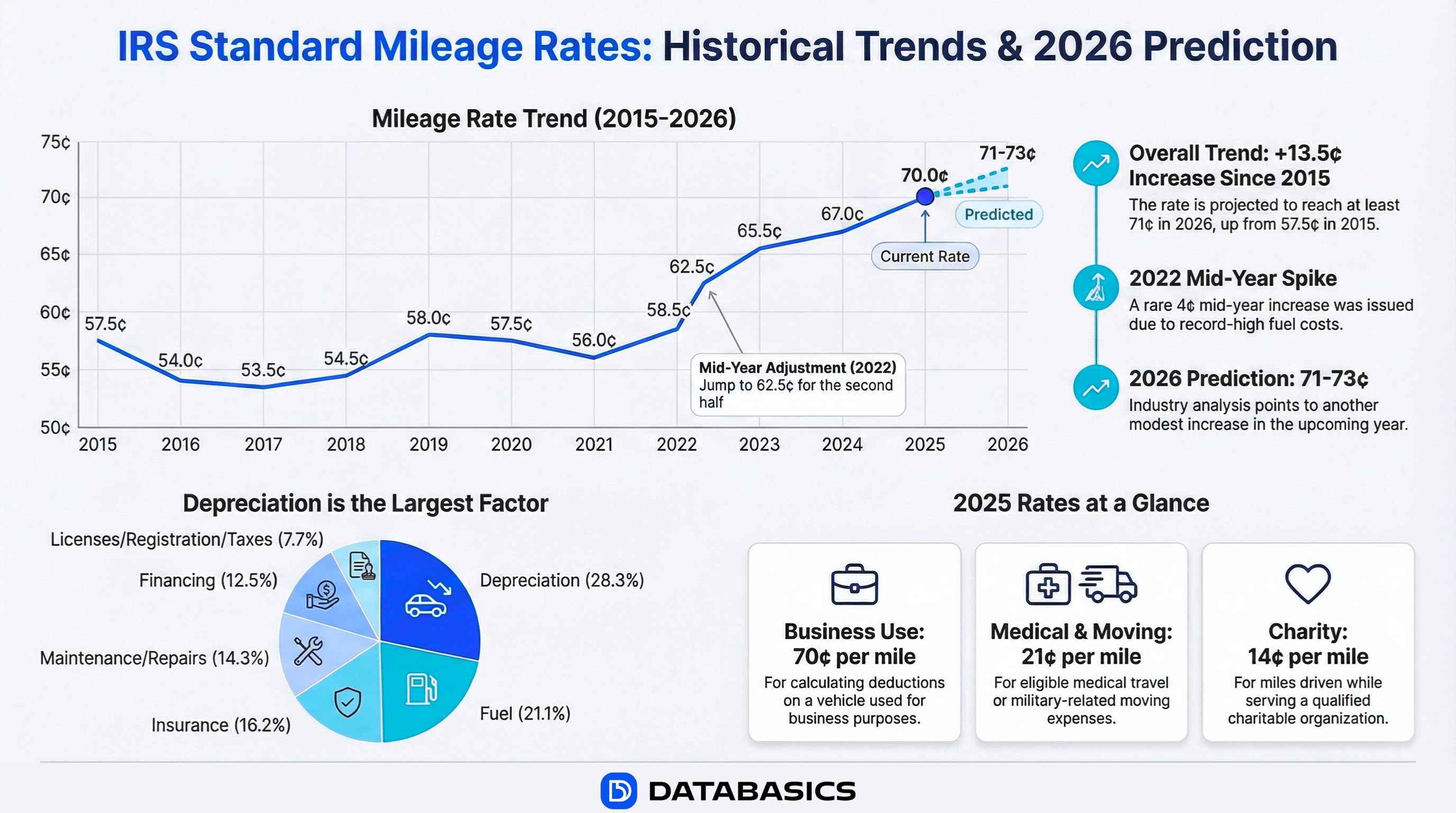
Although the final 2026 rate will not be released until late 2025, industry analysts currently estimate a rate between 71 and 73 cents per mile. The IRS uses current data from sources like the Energy Information Administration to track fuel costs and gas prices, which contribute to upward pressure on the rate. The federal mileage rate (also known as the IRS standard rate) often increases by small increments, such as three cents, to reflect changes in vehicle costs and car insurance premiums. This reflects continued increases in vehicle ownership costs across the market. The IRS will announce the official 2026 rate in December 2025.
A Look at the Last 10 Years of IRS Mileage Rates
The list below shows how the business mileage rate has changed over the past decade. These shifts illustrate how economic changes, fuel volatility, and rising repair and insurance costs have influenced the rate.
-
2015: 57.5 cents
-
2016: 54 cents
-
2017: 53.5 cents
-
2018: 54.5 cents
-
2019: 58 cents
-
2020: 57.5 cents
-
2021: 56 cents
-
2022 January to June: 58.5 cents
-
2022 July to December: 62.5 cents
-
2023: 65.5 cents
-
2024: 67 cents
-
2025: 70 cents
- 2026: 72.5 cents
For 2025, the IRS standard mileage rate is set at 70 cents per mile for business use and 21 cents per mile for medical and military moving purposes. If current trends continue, the IRS mileage rate could surpass 70 cents per mile in 2026. Tracking these changes helps businesses and individuals maximize tax savings and claim tax deductions during tax season. The steady increase is clear. This trend is why many organizations are searching for smarter ways to manage reimbursement programs. The 2025 rates for mileage are 70 cents per mile for business use, 21 cents per mile for medical or moving purposes, and 14 cents per mile for charitable services.
Electric Vehicles and Their Impact on Mileage Costs
Electric vehicles are becoming a larger part of the vehicle market and their cost structure differs from gas powered cars. When calculating the cost of operating an electric or personal vehicle for business purposes, both actual costs and actual expenses—including registration fees—are considered. EVs do not require gas, but they still have operating costs that influence the IRS calculation.
Key EV cost factors include:
-
Charging costs that vary between home charging and public charging
-
Lower maintenance because EVs have fewer moving parts
-
Potentially higher repair expenses when service is needed due to specialized components
-
Higher insurance premiums in many cases
-
Fast changing depreciation rates
While EVs generally reduce fuel expenses, the IRS uses one unified rate for all vehicle types. As EV adoption increases, their unique cost profile becomes a growing factor in how future mileage rates are set.
How Businesses Can Reduce Costs Through Smarter Mileage Policy
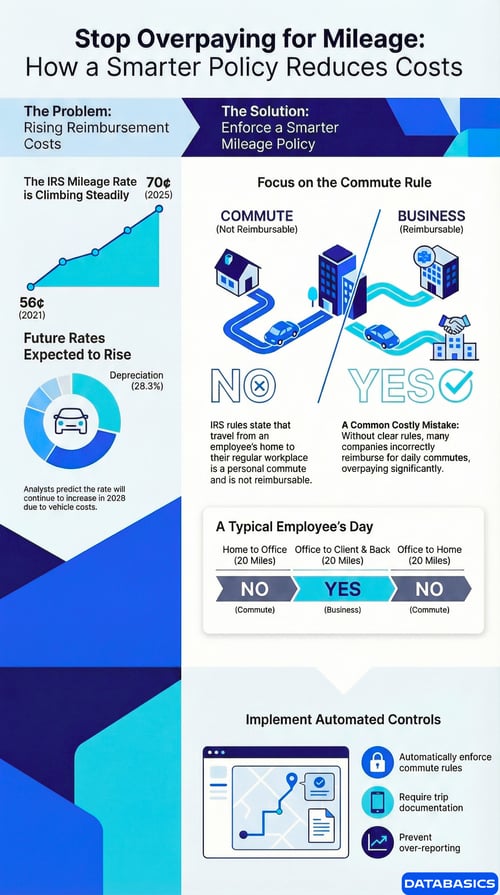 Rising IRS mileage rates directly increase reimbursement costs for employers. One of the most effective ways to manage these expenses is to enforce a clear and compliant mileage reimbursement policy that aligns with relevant state laws and addresses the needs of both small business owners and self-employed individuals. Establishing such a policy helps organizations define what qualifies as business use, ensuring that only eligible trips are reimbursed. Accurate expense reports are essential for documenting business use of vehicles and ensuring compliance with reimbursement policies. Among the most impactful strategies is proper management of commute mileage.
What Is Commute Mileage
Commute mileage is the distance an employee travels from home to their regular place of work and back. The IRS does not allow commute miles to be reimbursed as business miles. Only miles driven for qualified business purposes after the employee arrives at their primary work location, or travel between business-related locations, are eligible for reimbursement. Improper reimbursement of commute miles could result in taxable income for the employee. Exceptions exist for certain cases, such as a permanent change of station for active-duty military or travel for medical purposes, where specific IRS rules may apply.
Many employees mistakenly claim commute miles as business miles. When this happens, companies overpay mileage reimbursements without realizing it. Properly enforcing commute mileage rules can significantly reduce unnecessary mileage costs.
Example of Commute Mileage vs Business Mileage
Imagine an employee named Sam who lives 20 miles from the office.
-
Sam drives 20 miles from home to the office. This is commute mileage and is not reimbursable.
-
After arriving at the office, Sam drives 10 miles to visit a client. This is business mileage and is reimbursable.
-
Sam then drives 10 miles back to the office. Also reimbursable.
-
At the end of the day, Sam drives 20 miles home. This is commute mileage and is not reimbursable.
Summary of the example
-
Commute miles: 40 miles (20 each way)
-
Business miles: 20 miles
-
The employee is reimbursed only for the 20 qualifying business miles.
Without clear rules and system controls, some organizations end up reimbursing the full 60 miles instead of the correct 20 miles. With a higher IRS rate, these overpayments become even more costly.
How a System Like DATABASICS Helps Companies Control Mileage Costs
Companies can protect their budgets by using automated business rules that prevent employees from claiming commute mileage. With DATABASICS Time and Expense, organizations can:
-
Enforce IRS compliant commute rules
-
Auto deduct commute distance from daily mileage
-
Require clear trip documentation
-
Provide employees with guidance to prevent accidental over reporting
-
Generate reports that highlight patterns of excessive mileage
By applying these controls, businesses can reduce mileage reimbursements by thousands of dollars annually, especially during periods where the IRS raises the rate.
Final Thoughts
The IRS mileage rate continues to rise due to increasing repair, insurance, and ownership costs. While no one can control the IRS rate itself, companies can control how they reimburse employees. Properly managing commute mileage, implementing automated checks, and adopting a clear policy can significantly reduce unnecessary spending. The IRS mileage rate is adjusted annually to reflect the current average cost of driving for work.
Stay Ahead Of Both IRS And GSA Rate Changes
You have the 2026 IRS mileage outlook. Next, see how the current GSA per diem and mileage rates for 2025 affect travel budgets, reimbursements, and policy updates for your teams.
Read the GSA Per Diem & Mileage GuideReady to see how DATABASICS brings mileage, per diem, and project controls into one system of record for finance?
Request a Demo
Best DCAA timesheet software for government contractors (2026)
Read Now
Expense Reporting Compliance: Policy to Audit Trail
Read Now
From Timesheet to Audit Trail: Building Compliance Into Time Reporting
Read Now
Dynamics GP to Business Central Migration: What Happens to Your Timesheets and...
Read Now
Unify Timesheets and Expenses to Speed Project Billing
Read Now
Evaluating NetSuite? Five Timesheet and Expense Reporting Questions to Ask...
Read Now