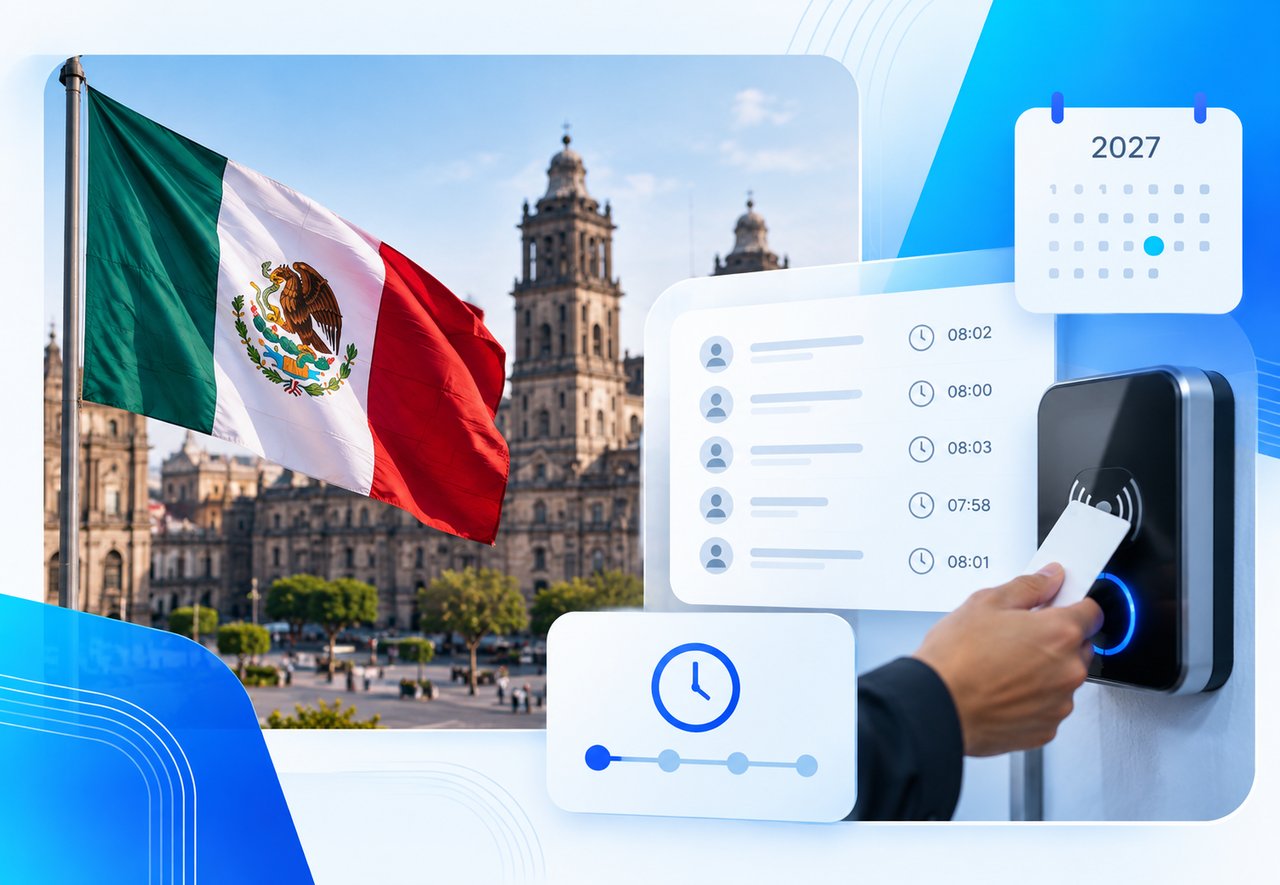


Beginning January 1, 2027, the maximum ordinary workweek in Mexico drops from 48 hours to 46 hours, the first step in a phased reduction to 40 hours by 2030. On the same date, employers become subject to an electronic record-keeping obligation covering each employee's workday.
The reform was published in Mexico's Diario Oficial de la Federación on May 1, 2026, following the constitutional amendment earlier that year, so this is settled law rather than a pending proposal. The DOF decree confirms the phase-in schedule, and STPS has also described the reform as strengthening labor inspection through electronic workday records. What is not settled is the technical detail: the Secretaría del Trabajo y Previsión Social (STPS) has not yet published the guidelines defining the scope of the electronic record and any exceptions to it.
For a U.S. company with a subsidiary, plant, shared-services center, or employees and other tracked workers in Mexico, this is not only a legal question for outside counsel. It is a question about what your timekeeping system captures, how corrections are preserved, which overtime rules it applies and when, and what it can produce when a labor inspector asks for an employee-level record.
If you are the Controller, the payroll manager, or the ERP owner, the work you are accountable for does not change. Payroll still has to run accurately. The close still has to be defensible. What changes is the evidence you need to have on hand, and the date by which your system has to be capturing it. For DATABASICS customers, this is a configuration review across time capture, overtime rules, breaks, audit trails, reporting, and integrations.
This article is for general information and planning. It is not legal advice. Employers should confirm requirements with legal counsel, payroll providers, and their DATABASICS implementation team.
Quick answer
- Mexico's maximum ordinary workweek drops to 46 hours on January 1, 2027, then continues decreasing until it reaches 40 hours in 2030.
- Employers must maintain electronic workday records that can be made available to labor authorities.
- Meal and rest-break handling matters because some breaks may count as working time when employees cannot leave the workplace.
- Employers should review overtime thresholds, daily-hour alerts, audit trails, employee-level reports, and export readiness.
- DATABASICS can support the operational timekeeping review, depending on each customer's configuration, integrations, and final STPS technical specifications.
Who should read this
This article is for U.S. companies with employees or operations in Mexico, especially finance, payroll, HR, compliance, ERP, NetSuite, and Sage Intacct teams that need to review how time records move from capture to approval, payroll, reporting, and audit.
What is changing in Mexico in 2027
The reform amends the Ley Federal del Trabajo to reduce the maximum ordinary workweek in annual steps, as shown in the DOF decree:
| Effective date | Maximum ordinary workweek |
|---|---|
| January 1, 2027 | 46 hours |
| January 1, 2028 | 44 hours |
| January 1, 2029 | 42 hours |
| January 1, 2030 | 40 hours |
Beyond those numbers, here's what needs to be kept in mind:
- Wages and benefits cannot be reduced as a result of the shorter workweek. The reduction is in hours, not in pay.
- Employers must keep an electronic record of each employee's workday, available to labor authorities. STPS has described electronic workday registration as part of stronger labor inspection, and the agency is responsible for issuing the scope of that obligation and any exceptions. That guidance is still pending as of this writing.
- Ordinary hours plus overtime may not exceed 12 hours in a single day, according to STPS's description of the reform.
- Weekly overtime limits and premium tiers move with the phase-in. The DOF transition table keeps weekly overtime at 9 hours in 2027, then increases the extraordinary-hours limit in later years. Overtime in Mexico is paid at a premium, with a higher tier applying beyond a defined threshold. Employers should confirm how double-time and triple-time tiers apply before configuring payroll rules.
- Employees under 18 may not work overtime. This restriction predates the reform and continues to apply.
The practical effect is that the number of ordinary hours in a week becomes an effective-dated value that changes four times over four years, and the threshold at which premium pay begins moves with it.
Meal and rest breaks are not only a 2027 issue
 Break rules are the part of this that companies most often discover late, because they are not new. Article 63 of the Ley Federal del Trabajo already provides that during a continuous shift, the employee is granted a rest period of at least half an hour. Article 64 is the one that reaches your timekeeping configuration directly: when the employee cannot leave the place where services are performed during rest or meal periods, that time is counted as effective working time.
That is a paid versus unpaid determination that depends on the facts at each site, not a setting you can apply company-wide by default. If employees at a plant or a secured facility cannot leave during their meal period, that time may count toward the ordinary workweek, and the workweek ceiling is about to get lower.
These two questions should be thought through before January:
- Does the system capture meal-start and meal-end as distinct timestamps, or does it apply an automatic deduction?
- Where a break is treated as working time, does it flow into the hours total the overtime threshold is calculated against?
An automatic 30-minute deduction applied to every shift may be fast to configure, but it can be difficult to defend if the record does not match what actually happened.
What should employers review in their timekeeping system?
The reform converts a payroll calculation into a record-keeping obligation. Reviewing your current setup against the following list is a reasonable starting point:
- Capture exact start and end timestamps for each employee's workday
- Capture meal-start and meal-end timestamps, distinct from shift start and end
- Preserve the original employee-entered record after an authorized correction, rather than overwriting it
- Maintain an audit trail of edits, approvals, and who made them
- Apply effective-dated overtime thresholds, so the 46-hour rule takes effect on January 1, 2027 without a manual reconfiguration on the same day
- Calculate premium pay tiers, including the higher tier beyond the applicable threshold
- Alert managers as daily and weekly limits are approached or exceeded
- Prevent or flag overtime for employees under 18
- Distinguish paid and unpaid break time and reflect that distinction in hours totals
- Produce employee-level reports rather than aggregate summaries
- Export records in a format that can be provided for review
The audit-trail item is the one most likely to be a gap. A system that lets a supervisor edit a punch in place, with no retained original, produces a clean record and no evidence. When the question is whether the record reflects what the employee actually worked, the correction history is the answer.
How DATABASICS can help
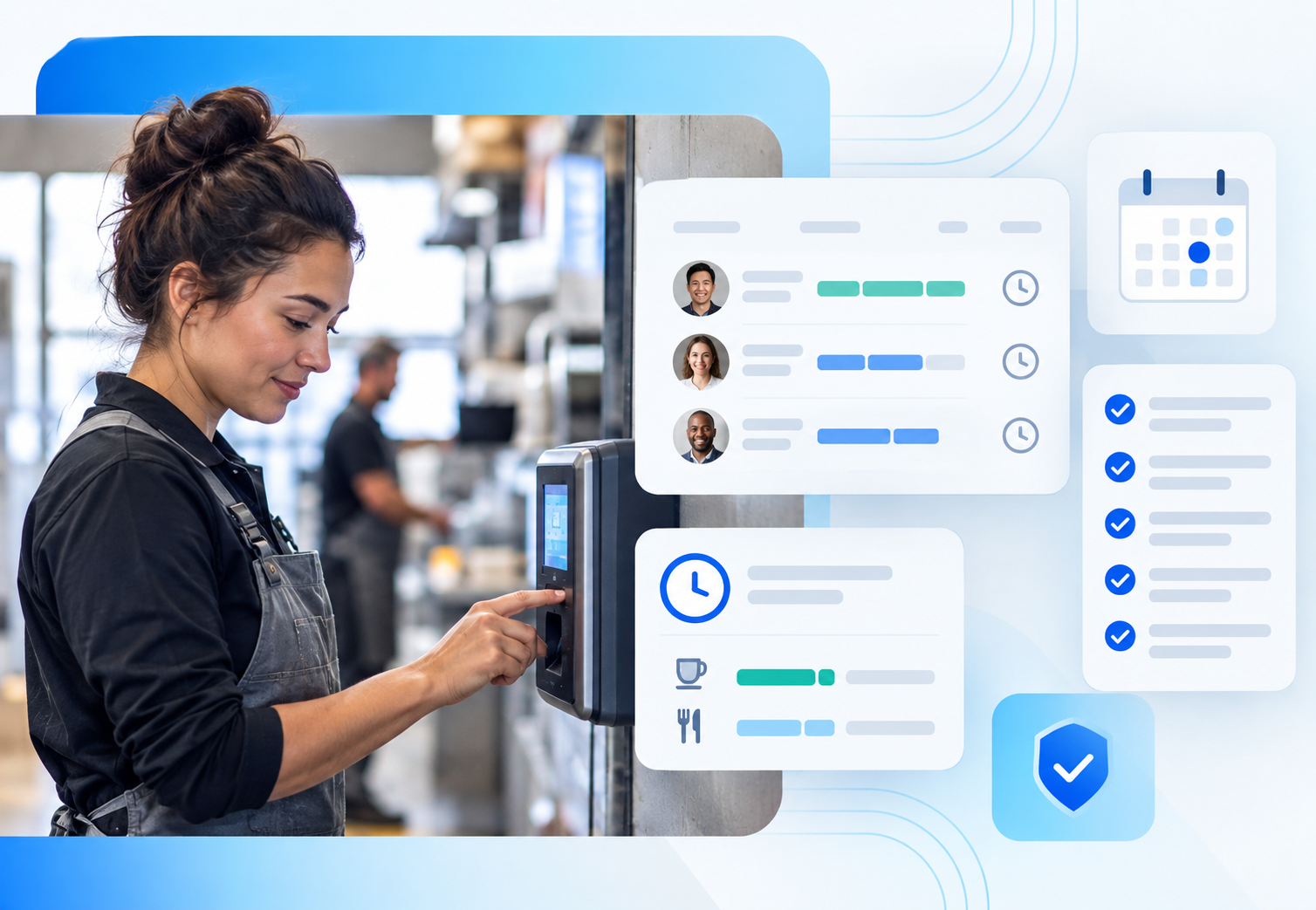 DATABASICS Time supports exact timestamp collection through Clock In/Out Attendance, Time In/Out by Project/Activity, and Dual Mode Clock In/Out. It can track clock-in, clock-out, meal-start, meal-end, and break timestamps across web and mobile applications.
DATABASICS can support the review in several operational areas:
- Time capture. Preserve original employee-entered timestamps after authorized corrections and distinguish paid and unpaid breaks.
- Policy rules. Apply effective-dated policy rules, support configurable overtime tiers including double-time and triple-time, restrict overtime by employee profile, and flag legal-limit exceptions.
- Alerts and approvals. Alert managers when daily thresholds are approached and preserve approval activity for review.
- Reporting and export. Generate detailed employee-level reports and export records in formats such as CSV, Excel, XML, PDF, or through an API.
Effective-dated policy rules are worth calling out, because they address the specific shape of this reform. The ceiling changes on four separate January 1 dates. A rule set that carries its own effective date means the 46-hour threshold applies on January 1, 2027, and the 44-hour threshold applies on January 1, 2028, without relying on a manual setting change in the middle of a pay period.
None of this is a configuration you complete alone. DATABASICS works with customers to review policy setup, employee profiles, approval flows, and integrations as requirements change, which is the part that matters when a rule set has to be revisited four years running. Final setup depends on each customer's configuration, workforce policies, integrations, legal interpretation, and any final STPS technical specifications.
What NetSuite, Sage Intacct, and ERP customers should review
Companies using NetSuite, Sage Intacct, Microsoft Dynamics, SAP, Oracle, or another ERP should review how timekeeping data moves into payroll, finance, project accounting, and reporting workflows. This is especially relevant when the ERP is the downstream finance or payroll system, but the detailed time record originates somewhere else. The relevant question is not usually whether the ERP can store hours. It is whether the record that reaches payroll carries the detail the Mexico requirements assume: separate meal timestamps, the correction history behind an adjusted punch, and the overtime tier each hour was classified into.
DATABASICS can help capture, validate, approve, report, and export time data that may feed downstream ERP or payroll systems. Exact field mappings, sync timing, posting targets, and approval workflows depend on each customer's integration setup, which is why this is a review conversation rather than a settings change.
Worth confirming with whoever owns the integration:
- Which fields move from timekeeping to payroll, and whether meal and break detail is among them
- Where the audit trail lives after the export, and whether it remains retrievable at employee level
- How a correction made after an export is handled downstream
- Whether the Mexico entity's employees are on the same policy set as the U.S. workforce, and whether they should be
Configuration review checklist
For current DATABASICS customers with employees in Mexico, the practical review should cover four areas:
- Employee and policy setup. Confirm which employees are covered, whether employees under 18 are identified, and which Mexico-specific policy groups apply.
- Time capture and breaks. Confirm that clock-in, clock-out, meal-start, meal-end, and break timestamps are captured in the right workflows.
- Overtime and exceptions. Confirm that effective-dated weekly thresholds, premium tiers, daily-hour alerts, and employee-profile restrictions are configured and tested.
- Audit, reporting, and exports. Confirm that original timestamps, corrections, approvals, employee-level reports, and export formats are available for review.
DATABASICS customers should use the downloadable configuration checklist with their implementation, payroll, legal, and ERP owners before January 1, 2027.
Frequently asked questions
What are Mexico's 2027 workweek changes?
Effective January 1, 2027, the maximum ordinary workweek in Mexico is reduced from 48 hours to 46 hours. It continues to decrease in annual steps to 44 hours in 2028, 42 hours in 2029, and 40 hours in 2030. The reform was published in the Diario Oficial de la Federación on May 1, 2026. Wages and benefits may not be reduced as a result of the shorter week.
Does Mexico require electronic time records?
Yes. The reform requires employers to maintain an electronic record of each employee's workday, available to labor authorities, beginning January 1, 2027. The STPS is responsible for issuing the guidelines defining the scope of that obligation and any exceptions, and that guidance had not been published as of September 2026.
How should employers track overtime in Mexico?
Overtime is paid at a premium, with a higher tier applying beyond a defined threshold, and both the weekly overtime cap and the ordinary-hours ceiling shift during the phase-in. Ordinary plus overtime hours may not exceed 12 hours in a single day according to STPS's description of the reform. Employers should track hours at the individual-day level, apply the thresholds in effect for that year, and confirm the applicable tiers with counsel and their payroll provider.
Are meal and rest breaks part of the new 2027 law?
Break requirements are not new. Article 63 of the Ley Federal del Trabajo already provides for a rest period of at least half an hour during a continuous shift, and Article 64 provides that when an employee cannot leave the workplace during that period, the time counts as effective working time. What changes in 2027 is that the ordinary-hours ceiling those hours count toward is lower.
Can DATABASICS support Mexico timekeeping requirements?
DATABASICS Time supports exact timestamp capture, meal and break timestamps, preserved original entries after authorized correction, audit trails, effective-dated policy rules, employee-level reporting, and export. Whether a given configuration meets the requirements applicable to a specific employer depends on that employer's setup, workforce policies, legal interpretation, and any final STPS technical specifications.
Can DATABASICS calculate Mexico overtime rules?
DATABASICS supports configurable overtime tiers, including double-time and triple-time, effective-dated thresholds, daily and weekly limit alerts, and overtime restriction by employee profile. The specific thresholds and tiers configured should be confirmed with legal counsel and your payroll provider.
Can DATABASICS help NetSuite or Sage Intacct customers with Mexico operations?
DATABASICS can capture, validate, approve, report, and export time data that may feed downstream ERP or payroll systems, including NetSuite, Sage Intacct, Microsoft Dynamics, SAP, and Oracle. Exact mappings, sync timing, posting targets, and approval workflows depend on each customer's integration setup and should be reviewed with the DATABASICS team.
What should current DATABASICS customers review before January 1, 2027?
Employee profiles for Mexico-based staff, minor status and overtime restrictions, the effective-dated 46-hour threshold, premium pay tiers, daily 12-hour alerts, paid versus unpaid break handling, audit trail retention, employee-level reporting, and export readiness. Requesting a configuration review is the fastest way to work through that list with someone who knows your setup.
Next step
Request a DATABASICS timekeeping configuration review for Mexico operations. We will walk your current setup against the checklist above and identify what needs to change before January 1.
If you are earlier in the process, talk to DATABASICS about timekeeping, overtime, reporting, and ERP integration requirements for Mexico operations.
Sources
- Diario Oficial de la Federación, Decreto por el que se reforman, adicionan y derogan diversas disposiciones de la Ley Federal del Trabajo, en materia de reducción de la jornada laboral, published May 1, 2026. https://sidof.segob.gob.mx/notas/5786537
- Secretaría del Trabajo y Previsión Social (STPS), En el segundo año de gobierno de la presidenta Claudia Sheinbaum, México avanza hacia la jornada laboral de 40 horas, September 3, 2026. https://www.gob.mx/stps/prensa/en-el-segundo-ano-de-gobierno-de-la-presidenta-claudia-sheinbaum-mexico-avanza-hacia-la-jornada-laboral-de-40-horas?idiom=es
- Secretaría del Trabajo y Previsión Social (STPS), Reducción de la jornada laboral a 40 horas: preguntas frecuentes. https://www.gob.mx/stps/documentos/reduccion-de-la-jornada-laboral-a-40-horas-preguntas-frecuentes
- Ley Federal del Trabajo, Articles 63 and 64 (rest and meal periods). https://www.ordenjuridico.gob.mx/Documentos/Federal/html/wo125151.html
- Ogletree Deakins, Mexico's 40-Hour Workweek Amendment Reaches Its Final Stage (secondary source, employment law firm analysis). https://ogletree.com/insights-resources/blog-posts/mexicos-40-hour-workweek-amendment-reaches-its-final-stage-key-insights/
- Baker McKenzie, Mexico: Major Labor Reform to Gradually Reduce the Work Week, April 2026 (secondary source). https://www.bakermckenzie.com/en/insight/publications/2026/04/mexico-federal-labor-law-reform-shortens-work-wee
- Littler, México reduce la jornada laboral (secondary source). https://www.littler.com/news-analysis/asap/mexico-reduce-la-jornada-laboral

Timesheets and Expense Reporting Software: The Top Questions We Hear From Buyers
Read Now
Best DCAA timesheet software for government contractors (2026)
Read Now
Expense Reporting Compliance: Policy to Audit Trail
Read Now
From Timesheet to Audit Trail: Building Compliance Into Time Reporting
Read Now
Dynamics GP to Business Central Migration: What Happens to Your Timesheets and...
Read Now
Unify Timesheets and Expenses to Speed Project Billing
Read Now