

If you’re implementing or expanding NetSuite, and evaluating time and expense solutions, there’s an important question to answer early:
Will native NetSuite capabilities meet your needs, or should a specialized solution be part of your evaluation?
For some teams, simple time entry and expense reporting may be all they need. For example, native NetSuite only does Project, task, class, or work-order tracking in the timesheet. For requirements that need more support for project costing, workforce policies, corporate cards, and compliance, looking at a third-party solution might be the answer.
Evaluating those requirements early can help you identify gaps that might require potential workarounds, understand the full scope, and budget more confidently.
You don’t need a finished requirements document to start. These five questions can help you identify what matters most.
Five questions to answer before you shortlist solutions:
1. What must your time data support beyond a timesheet?
A weekly timesheet may be enough for some organizations. Others need time data to support attendance, labor costing, billing, and workforce policies.
Consider whether you need:
- Clock-in/clock-out and attendance
- Project, task, class, or work-order tracking
- Mobile or field time entry
- Geofencing or shared clocks
- Overtime and double-time rules
- Meal and rest-break compliance
- PTO and leave management
Where does your team currently rely on spreadsheets, duplicate entry, or manual corrections?
Bring those examples into your evaluation. A feature checklist is useful, but seeing how a solution handles your actual work is more revealing.
2. Where does expense reporting still require manual work?
Submitting an expense report is only one step. Employees need an easy way to provide the right information, managers need enough context to approve it, and finance needs accurate coding and documentation.
Consider your requirements for:
- Mobile receipt capture and OCR
- Corporate card feeds and reconciliation
- Reimbursements
- Mileage and per diem
- Travel advances
- Duplicate detection
- Multi-level approvals
- Project, grant, fund, or departmental allocation
- AI-assisted review to flag potential errors and policy exceptions
What causes the most follow-up today, and how would the proposed solution reduce it?
Use the answer to distinguish must-have capabilities from nice-to-haves. Reducing friction can improve adoption while giving managers and finance fewer exceptions to resolve.
3. What has to happen before data reaches NetSuite?
 This may be the most important question to ask early.
What validation, policy enforcement, allocation, and approval need to happen before time and expense data is posted to NetSuite?
If the answer includes complex business rules or compliance requirements, bring a real example to vendor conversations. Ask how it is handled, where manual intervention remains, and what is included in the proposed solution.
4. How much complexity will you have tomorrow?
Evaluate today’s challenges alongside the changes you can reasonably anticipate:
- More employees or locations
- Additional subsidiaries
- More projects or grants
- International operations
- Expanded corporate-card programs
- More complex labor requirements
- New compliance obligations
A solution that works for a basic timesheet and expense report today may become a constraint as the organization grows.
5. Can employees work easily while finance gets the detail it needs?
Employees and managers need straightforward entry and approvals. Finance needs accurate coding, supporting documentation, and visibility into exceptions.
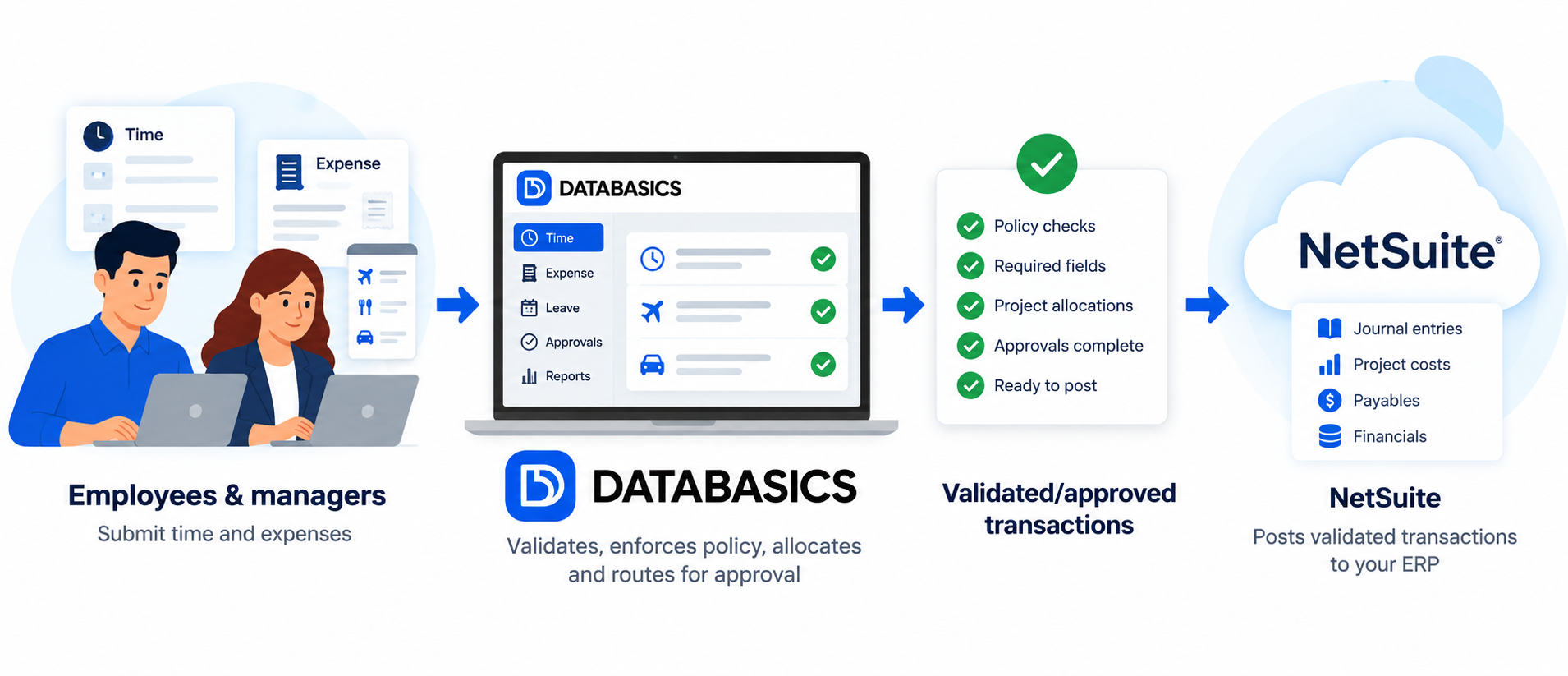
During your evaluation, ask vendors to demonstrate the complete process, including how exceptions are resolved and which data reaches NetSuite.
What’s the one time or expense challenge you want your next solution to solve?
Start with your biggest challenge. You don’t need to have your NetSuite plan, or your time and expense requirements fully defined to speak with DATABASICS.
An early conversation can help you:
- Identify requirements to include in your selection process.
- Separate must-have capabilities from nice-to-haves.
- Decide what to ask vendors to demonstrate.
- Surface scope and integration considerations that could affect your budget.
DATABASICS extends NetSuite for time, attendance, PTO, expense, and corporate-card processes: from capture through validation, allocation, and approval - with NetSuite remaining the financial system of record.
Exploring your options?
Bring your biggest challenges to a discovery conversation with DATABASICS. We’ll help you identify the requirements, demonstration questions, and scope considerations to include in your evaluation.
Talk with DATABASICS about your biggest challenge.