Every vendor at every conference right now says they use AI. Some of them mean it. A lot of them mean they added a rule-based automation and gave it a better name.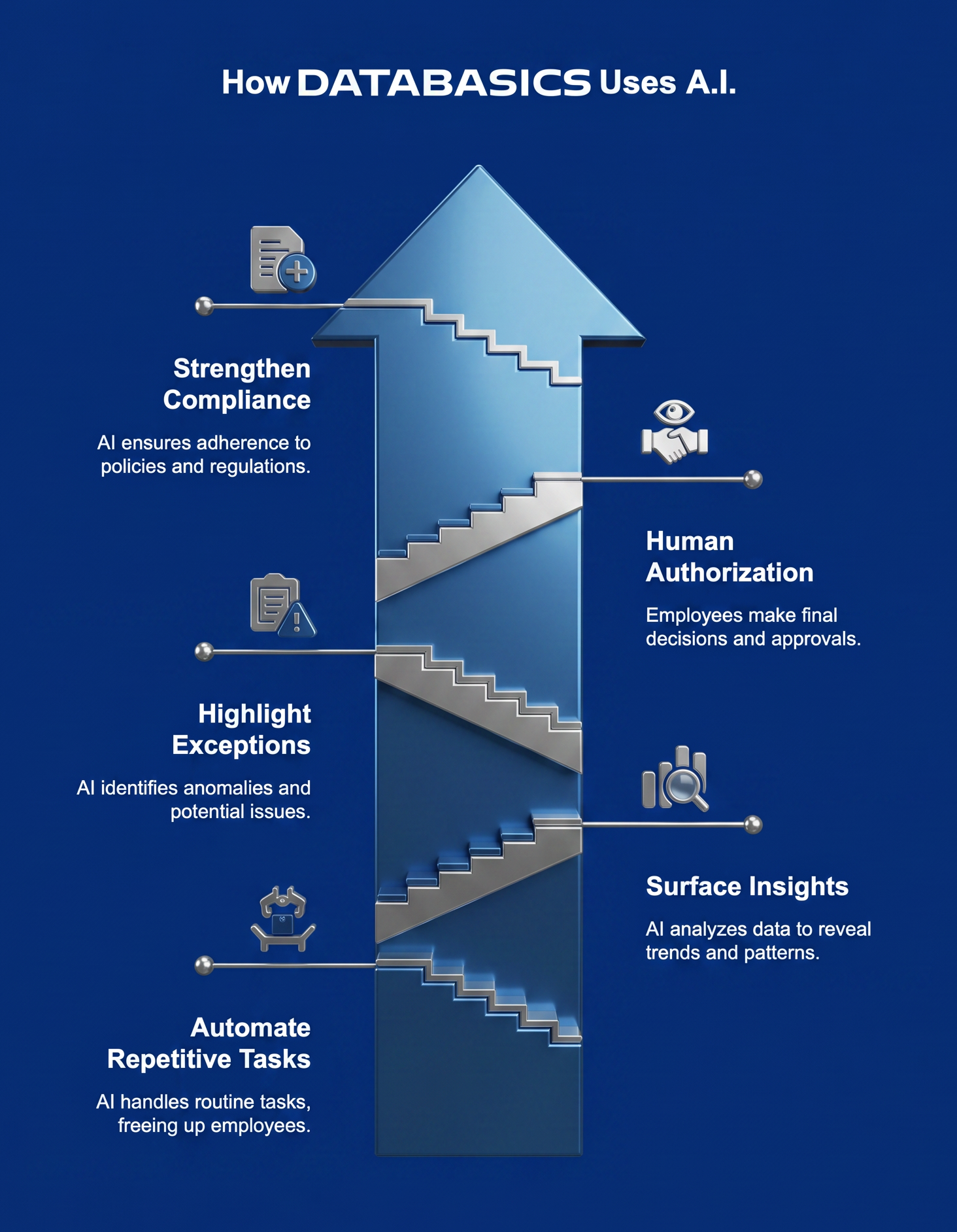
It’s a fair question. And the answer, once you get past the marketing, matters more to finance and compliance teams than the buzzword itself.
Here’s what we actually have, how it works, and why we’ve built it the way we have.
AI vs. Automation: Why does this distinction matter?
Organizations are under constant pressure to move faster with limited resources. Finance teams must process expenses quickly. Managers need visibility into staffing and utilization. Project leaders must balance deadlines, budgets, and resource availability. Compliance teams need to catch issues before they become audit findings.
AI can help with all of that. But "AI" has become a marketing term that gets applied to anything from genuine machine learning to a simple if/then rule that fires when an expense is over $50. When your DCAA auditor asks how a decision was made, "the AI flagged it" is not an acceptable answer. You need to know what actually happened and why.
Software alone does not replace judgment. In business-critical processes, context still matters. Policies still matter. Accountability still matters.
That principle shapes every AI decision we make at DATABASICS. Strong AI in business software does not remove people from the process. It helps the right people focus on the right decisions faster.
What AI is actually good at in this space
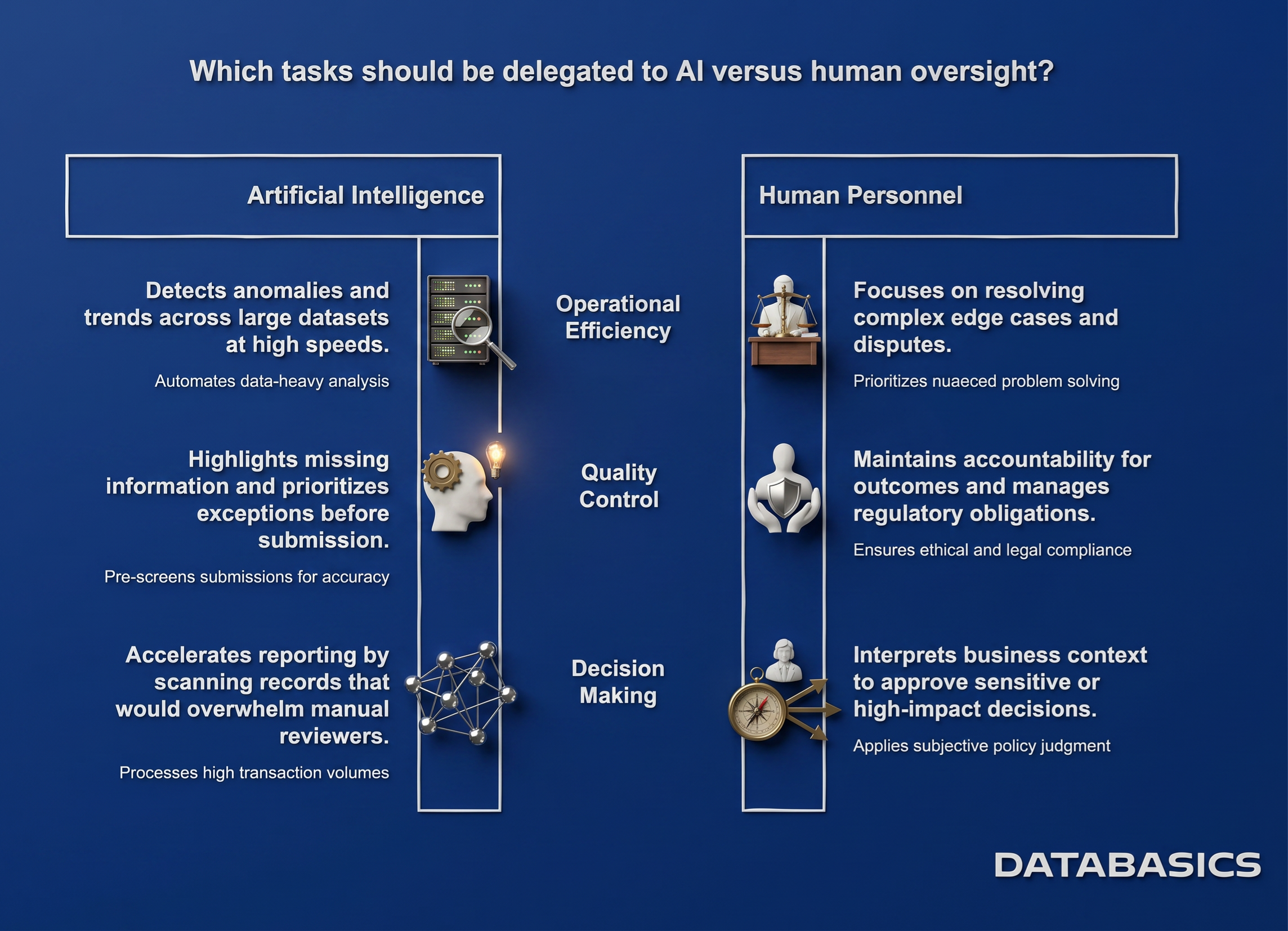 Used responsibly, AI improves both efficiency and control. It’s especially valuable where teams manage high transaction volume, policy enforcement, distributed workforces, and complex approvals.
Here is where AI adds real value in time and expense management:
- Detecting anomalies across large datasets that a human reviewer would miss in manual spot-checks
- Highlighting missing or incomplete information before a submission hits the approval queue
- Prioritizing exceptions that need human review, rather than forcing reviewers to scan every record
- Accelerating reporting and data analysis
- Identifying trends earlier than manual review alone allows
And here is where people remain essential, regardless of what the AI does:
- Approving sensitive or high-impact decisions
- Interpreting business context and applying policy judgment
- Managing regulatory obligations
- Resolving edge cases and disputes
- Maintaining accountability for outcomes
AI embedded in workflows you already use
DATABASICS is not treating AI as a separate module you opt into. The focus is on embedding intelligence directly into the workflows organizations already depend on for time tracking, expense management, spend control, scheduling, reporting, and operational oversight.
Standalone AI tools create friction. They require retraining, introduce governance concerns, and often operate outside the systems of record that support compliance. Embedded AI works differently. It operates inside established processes, helping teams move faster while keeping visibility and control intact.
The most effective AI deployments are embedded into familiar processes. Users get help where they already work, rather than being pushed into separate tools that disrupt adoption and governance.
AI-powered expense management
Expense review is one of the clearest examples of where AI adds immediate value. Large submission volumes make it difficult for human reviewers to manually catch every issue, every time.
AI in our expense workflows can identify:
- Duplicate expense submissions
- Out-of-policy spending
- Missing receipts or incomplete documentation
- Unusual spending patterns that warrant a closer look
- Potential fraud indicators
The result is not just faster review. It’s more consistent policy enforcement, earlier risk detection, and shorter reimbursement cycles for compliant submissions. The human reviewer still approves or rejects. The AI makes sure nothing slips through unexamined.
AI workforce scheduling and resource planning
Resource planning has gotten harder as organizations support remote, hybrid, and project-based teams. Managers must align demand, availability, labor cost, utilization, and delivery commitments across constantly shifting priorities.
AI can help by optimizing resource assignments, forecasting staffing needs, reducing overtime exposure, and improving workforce utilization. For project-driven organizations, this extends to margin protection, schedule confidence, and stronger client delivery.
AI time tracking and compliance monitoring
Accurate time capture is essential for payroll, project accounting, billing, labor visibility, and compliance. Small delays or inconsistencies create larger downstream problems, especially for government contractors and DCAA-audited environments.
AI in time tracking can surface:
- Missing timesheets before the payroll deadline
- Late submissions that need follow-up
- Overtime risks before they become payroll errors
- Approval bottlenecks slowing down close cycles
- Compliance exceptions that need manager attention
For organizations already using audit-oriented reporting, AI strengthens existing oversight by surfacing risk signals sooner. Managers focus on the records that actually need action, rather than reviewing everything manually.
Want to see DBee in action?
Book a demo to see how AI-assisted expense review, compliance monitoring, and DBee work in a live environment built for finance teams.
Human-in-the-loop AI: the DATABASICS model
DATABASICS follows a Human-in-the-Loop model. AI supports work by recommending actions, highlighting risks, answering questions, and surfacing relevant information. People make the final decisions.
AI informs. People approve. Governance remains intact.
This is especially important in regulated and policy-sensitive environments where organizations need both speed and defensibility. The industries where this model matters most include:
- Government contractors operating under DCAA expectations
- Nonprofits managing grant compliance
- Healthcare organizations with strict privacy obligations
- Professional services firms billing against client engagements
- Project-based enterprises with multi-entity reporting requirements
In these environments, automation cannot come at the expense of accountability. AI should support decision-making, not obscure who made the call or why.
AI and data privacy: where we stand
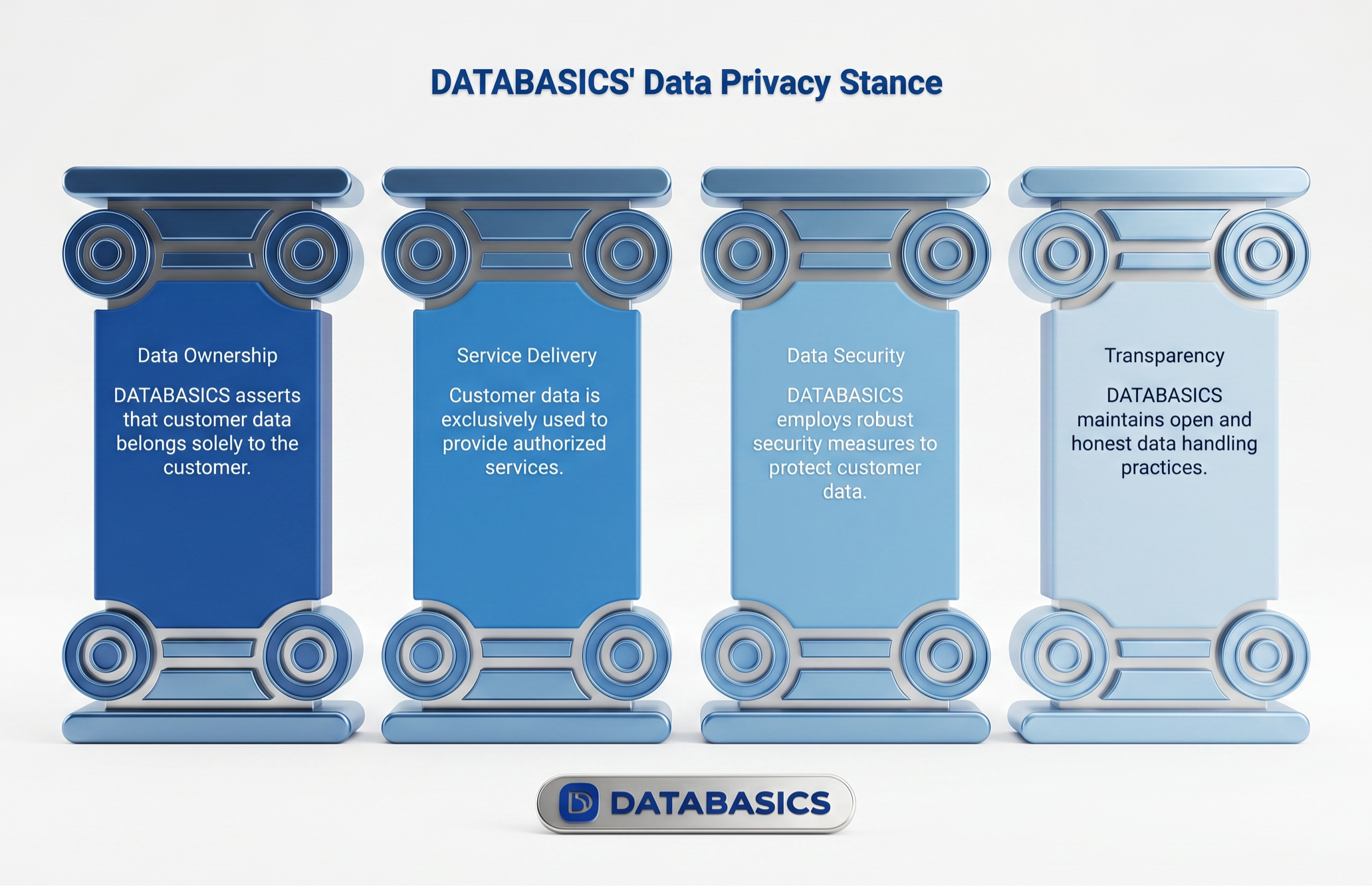
One of the biggest blockers to AI adoption is concern about data usage. Customers want to know who can access their information, how it is protected, and whether their data is being used for something beyond the services they authorized.
DATABASICS takes a clear position: your data belongs to you.
In practice, that means:
- DATABASICS does not use customer data to train public AI models
- Customer information is used only to deliver authorized services
- DATABASICS does not sell customer data
- DATABASICS does not share customer information for advertising purposes
Trust is not created by marketing language. It is earned through transparent practices, security controls, and clear accountability. Our security foundation includes role-based access controls, encryption, monitoring and auditing capabilities, and governance aligned with enterprise security expectations including SOC 1 Type II, SOC 2 Type II, PCI DSS Level 1, HIPAA (self-attested), and DCAA compliance.
AI features operate within the same security and permission boundaries customers already rely on. Intelligence does not bypass access control.
AI and compliance are not in conflict
A common concern is that AI introduces new compliance risk. In practice, responsible AI strengthens compliance by making policy enforcement more consistent and by identifying issues earlier.
Specifically, AI-powered review can:
- Flag policy violations before reimbursement or approval
- Detect anomalies that deserve audit review
- Highlight missing records or incomplete submissions
- Identify patterns linked to fraud, leakage, or approval delays
- Support faster exception management and documentation review
For organizations subject to DCAA expectations, internal control frameworks, project accounting standards, or healthcare-related requirements, this is not optional. AI should support auditability, transparency, and governance, not bypass them.
Control framework for AI-enabled features
DBee and related AI capabilities are evaluated as controlled system features, not informal automation. Every AI-enabled function maps to a compliance control area:
| Concern | Risk if poorly implemented | DATABASICS approach |
|---|---|---|
| Employee replacement | Loss of oversight, reduced confidence in decisions | Humans remain in the approval and decision path |
| Data privacy | Unauthorized use of sensitive customer information | Customer data is protected and limited to authorized services |
| Compliance | Unclear decisions, weak controls, audit exposure | AI is designed for transparency, auditability, and policy alignment |
| Workflow disruption | Low adoption and process fragmentation | AI is embedded into existing workflows and systems of record |
| Access control | Information exposed to unauthorized users | AI responses respect existing roles, permissions, and report access rules |
| Auditability | Decisions cannot be traced or reviewed | AI-supported activity is traceable to underlying records; source data is never obscured |
Meet DBee: the DATABASICS AI Assistant
DBee is our AI assistant, built to help users work faster with the information and workflows they already use in DATABASICS. The goal is not automation for its own sake. It is improved productivity with the controls, permissions, and visibility your organization requires.
In practical terms, DBee helps with tasks users already perform: reviewing audit-oriented reports, analyzing operational exceptions, building reports faster, and finding the right configuration more quickly. DBee can:
- Answer questions using your authorized organizational data
- Build and surface reports more efficiently
- Help users navigate workflows without opening a support ticket
- Summarize exception data for faster manager review
DBee is an assistive control and decision-support capability. It is not positioned as an autonomous decision-maker for financial, personnel, or audit-sensitive actions. When a decision requires accountability, a person makes it.
DBee recommends, summarizes, and flags exceptions. Approval, rejection, reimbursement, time certification, and corrective action remain human decisions, logged in the workflow audit trail.
What the future of AI at DATABASICS looks like
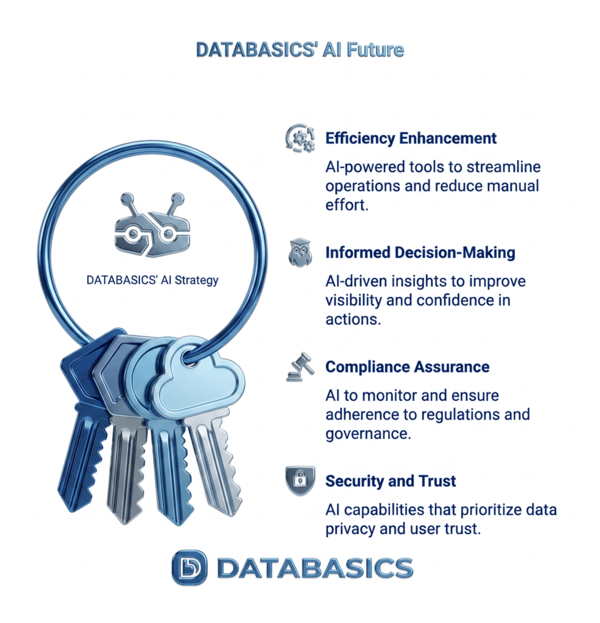 DATABASICS is investing in AI because it can help customers become more efficient, more informed, and more compliant. The areas we are actively developing include AI-powered expense auditing, spend management, workforce scheduling, resource optimization, compliance monitoring, predictive analytics, intelligent reporting, fraud detection, and operational insights.
Every one of those areas shares the same objective: use intelligence to reduce manual effort, improve visibility, and help organizations act earlier with greater confidence. And every capability we introduce goes through the same filter:
New AI capabilities are only introduced when they improve outcomes without weakening security, governance, or user trust.
That is a slower approach than some competitors take. We think it is the right one for the organizations we serve.
Principles that will not change
- Technology should support people. AI should make employees more effective, not less relevant.
- Security should not be compromised. Strong controls must remain foundational.
- Compliance should not be sacrificed. AI should reinforce process discipline and audit readiness.
- Customers remain in control of their data. Transparency and trust are not negotiable.
Artificial Intelligence is not a substitute for experience, judgment, or accountability. It is a tool. When applied responsibly, it can reduce administrative burden, improve decision-making, strengthen compliance, and surface opportunities that would otherwise be missed.
The standard we hold ourselves to: build AI that supports people, protects data, and delivers measurable business value. That is how AI should work in business software.
Frequently Asked Questions
No. The DATABASICS approach is to use AI to automate repetitive tasks, surface insights, and highlight exceptions. Final decisions and approvals remain with people. Approval, rejection, reimbursement, time certification, and corrective actions all require human authorization and are logged in the workflow audit trail.
No. Customer data is not used to train public AI models. Customer information is used only to deliver the services and functionality your organization has authorized. DATABASICS does not sell customer data and does not share it for advertising purposes.
When implemented responsibly, AI strengthens compliance rather than undermining it. It detects policy violations before reimbursement, flags missing documentation, identifies unusual spending patterns, and surfaces approval delays earlier. For organizations operating under DCAA expectations or internal control frameworks, this means catching issues before they reach an auditor, not after.
Many competitors label rule-based automation as AI. A rule that fires when an expense exceeds a threshold is not machine learning. DBee uses actual AI to analyze patterns across your data, answer natural-language questions about your workflows, and surface exceptions that rules alone would miss. The difference matters most during an audit, when you need to explain what the system did and why.
Yes. DBee operates within your existing role-based access controls and permission structure. It cannot surface data that a given user does not already have authorization to see. Intelligence does not bypass access control.