.png?width=1280&name=Integrations(2).png)


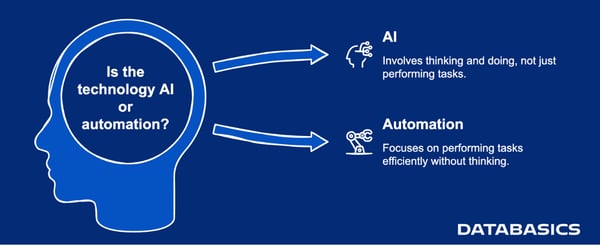
When we first wrote about AI and automation several years ago, AI was the aspirational future and automation was the exciting present. The message was simple: automation does the work, AI does the doing and the thinking.
That distinction still holds. But the problem has flipped.
Now, AI is no longer theoretical; real, substantive AI capabilities exist and are being deployed right now in enterprise software. The challenge isn't "when will AI arrive?" It's "is what that vendor is calling AI actually AI, or is it automation wearing a very convincing costume?"
The stakes are real. Organizations are making procurement decisions, signing multi-year contracts, and restructuring workflows based on claims that often don't survive a single follow-up question. So let's slow down, look at this clearly, and call things what they actually are.
The Original Distinction Still Holds
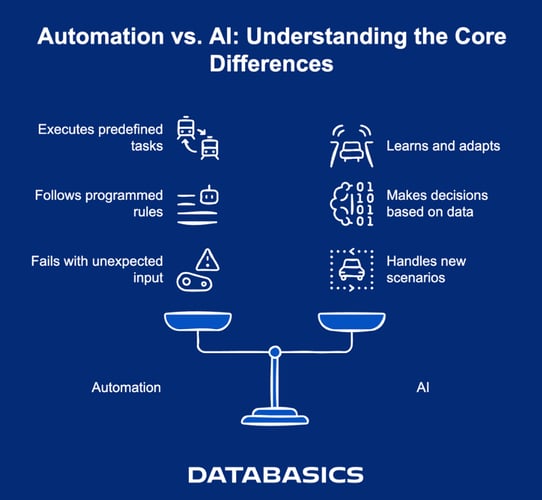 The core definition from our original post remains accurate and worth restating plainly:
- Automation executes predefined tasks based on rules a human set. It does the work. It does not think. It does not adapt. If the input changes in a way it wasn't programmed to handle, it fails or worse, silently produces wrong output.
- AI — genuine AI — learns, adapts, and makes decisions based on data it has never explicitly been programmed to handle. It can encounter a scenario it has never seen before and reason its way to an appropriate response.
The word intelligence in artificial intelligence is not decorative. It means something.
Automation is like a train: fast, reliable, but locked to its tracks. AI is more like a self-driving vehicle: it can navigate new terrain without someone telling it exactly where to turn.
Both have genuine value. Automation, done well, is a serious operational gift. The problem isn't automation; the problem is mislabeling it.
The New Problem: AI Washing and Agent Washing
Here's what's changed since we first wrote this post: vendors have discovered that calling automation "AI" is extraordinarily good for sales.
The industry now has a name for this: AI washing, and its more specific cousin, agent washing: the practice of relabeling existing automation tools, rule-based logic, and workflow triggers as sophisticated AI agents.
This isn't a fringe phenomenon. Gartner tested thousands of supposedly "agentic AI" products and found only 130 that actually qualified. And Gartner further predicts that over 40% of agentic AI projects will be canceled by end of 2027, largely because what was purchased didn't perform what was promised.
The FTC is already paying attention. In 2024, they launched Operation AI Comply specifically to crack down on deceptive AI marketing. The SEC charged Presto Automation for misleading investors with inflated AI claims.
Writer.com's enterprise guide to agent washing frames the issue well: "The problem isn't that these tools use deterministic logic — the problem is misrepresentation. When enterprises expect autonomous decision-making but get rigid automation, they set themselves up for failure."
The pattern is predictable: take a workflow that's been running for years, give it a new name, add "AI-powered" to the marketing copy, and charge more for it.
A Real Example: Receipt Matching Is Not AI
Here's a concrete example. When an employee submits an expense report and attaches a receipt, many systems will automatically match that receipt to the corresponding credit card transaction. Vendors love to call this "AI-powered."
It is not AI, but it is automation. Or in other words, it's a workflow. It is an if-then rule: if the amount on this receipt matches the amount on this transaction, and the date is within a reasonable window, and the merchant name aligns, then flag it as matched.
That's a predefined rule executing a predefined task. There is no learning. There is no adaptation. There is no reasoning. The system executed an instruction. If the receipt arrives in an unexpected format, or the merchant name is abbreviated differently, the system either fails or requires human correction.
OCR — optical character recognition — is the underlying technology that reads the receipt in the first place. And as Brimma Tech puts it plainly: "OCR is essentially pattern recognition software. It looks at an image, guesses what characters are on it, and converts them into text. That's it. OCR doesn't know what a pay stub is." Calling that AI isn't innovative marketing. It's inaccurate marketing.
More "AI-Powered" Claims That Are Actually Automation — In Expense & Time Tracking
Receipt matching is one example, but it's not alone. Here's a straightforward breakdown of features commonly marketed as AI-powered in expense and time tracking software and what they actually are:
| What Vendors Call It | What It Actually Is | The Tell |
|---|---|---|
| AI-powered receipt matching | Automation (rule-based workflow) | If amount + date + merchant = match → execute. No learning occurs. |
| AI expense categorization | Automation (lookup table / rules engine) | If merchant = "Delta" → category = "Travel." A human built those rules. |
| AI policy enforcement | Automation (conditional logic) | If amount > $X and category = "Meals" → flag. Predefined threshold. |
| AI approval routing | Automation (workflow trigger) | If submitted → route to manager. |
| OCR receipt reading | Automation (pattern recognition) | Reads characters from images. Does not understand meaning. |
| Anomaly detection that learns your team's patterns | Actual AI | ML model observes behavior over time and flags outliers it wasn't explicitly programmed to find. |
| Using NLP (natural language processing) to interpret ambiguous policy language | Actual AI | Language model applies contextual judgment to edge cases — not keyword matching. |
| Fraud detection that adapts to new schemes | Actual AI | Model updates its understanding of "fraud" without being manually reprogrammed. |
| Spend forecasting from unstructured signals | Actual AI | Synthesizes multiple data streams and adapts as context shifts. |
The bottom rows of that table represent what AI can genuinely do today. The problem is that the real capabilities get drowned out by the noise of everything else being called AI too.
What Real AI Actually Looks Like in This Space
To be clear: genuine AI in expense and time management is not science fiction. It exists. Here's what it actually looks like:
It learns without being reprogrammed. A real AI system observes your organization's historical spending patterns, not just categories, but context, timing, team behaviors and its suggestions improve over time without a human updating a rule.
It handles what it wasn't explicitly trained on. When automation encounters a scenario outside its rules, it breaks or skips it. AI uses inference and reasoning to navigate new terrain and either resolves it or flags it transparently for human review.
It understands language, not just data. Natural language processing allows a system to interpret the intent of a policy, not just match keywords. That's the difference between a system that reads "meals not to exceed $75 per person" and one that flags a $74.99 charge for one person appropriately but misses a $74.99 charge that was actually split across three people.
It surfaces insights you didn't ask for. Automation does what it was told. AI notices what you missed: duplicate vendor charges, unusual spend spikes, budget patterns that signal a problem before it becomes a crisis.
How to Ask Better Questions Before You Buy
When a vendor tells you their product is "AI-powered," here are three questions that will cut through the marketing very quickly:
1. "Does this feature learn and adapt over time, or does it execute predefined rules?"
If the answer involves words like "workflow," "trigger," "if/then," or "configuration" then you're looking at automation. That's fine. But it's not AI, and you should price and evaluate it accordingly.
2. "What happens when the system encounters a scenario it wasn't programmed for?"
Automation fails or skips it. Real AI applies reasoning and handles it, or, at minimum, flags it intelligently rather than silently producing wrong output. A vendor who can answer this question confidently is worth your time. A vendor who pivots to a demo is not.
3. "Can you show me where the model learns from new data?"
If there's no answer involving retraining cycles, feedback loops, or model improvement over time, you're looking at a static rule engine, not a learning system. Ask for specifics: What data does it train on? How often does it update? What does improvement look like in measurable terms?
Why This Matters Beyond Procurement
This isn't just a purchasing issue. The AI washing problem has real downstream consequences:
- Trust erodes. When an "AI-powered" system fails to do what was promised, organizations don't just lose confidence in that vendor and they lose confidence in AI broadly. That's a problem, because the genuine capabilities are real and worth investing in.
- Compliance risk increases. A system that does but doesn't think can be confidently wrong. If automation flags a receipt as policy-compliant because the amount and category matched, but misses a duplicate, a split receipt, or a fraudulent vendor; no one catches it unless a human is specifically looking.
- Entry-level employees lose the skills that come from understanding the work. When automation is sold as intelligence, people stop asking why the system did what it did. That's how compliance gaps become systemic.
Closing
We've been in this space for over 25 years. We've watched technology evolve from manual paper-based processes through spreadsheets, through the first wave of workflow automation, and now into what is genuinely an extraordinary moment for real AI capability.
We're not skeptical of AI. We're skeptical of the word "AI" being used to describe things that aren't. That distinction — between a system that executes and a system that thinks — is exactly what organizations need to hold onto as they evaluate every new product, every webinar demo, and every vendor claim that comes across their desk.
Call things what they are. The rest follows from there.
For more information on DATABASICS Time & Expense, contact us or call (800) 599-0434.

Unify Timesheets and Expenses to Speed Project Billing
Read Now
Evaluating NetSuite? Five Timesheet and Expense Reporting Questions to Ask...
Read Now
7 Questions to Ask a Dynamics Timesheet & Expense Reporting Vendor at Community...
Read Now
Mexico's 2027 workweek changes: what U.S. companies should review in their...
Read Now
AI Spending is Creating a New Spend Visibility Problem
Read Now
2027 GSA Per Diem and IRS Mileage Rates: Travel Reimbursement Guide (Updated...
Read Now