

Your Overtime Isn't Costing What You Think It Is
Unplanned overtime costs mid-market companies far more than the 1.5x wage premium. For a 150-person organization, the visible overtime spend is roughly $75,000-$150,000 annually (ADP, 2023). The real liability hides underneath: undetected wage and hour violations that become $200,000 or more in back pay and penalties when the Department of Labor audits (DOL Wage and Hour Division). Real-time time and leave management prevents these violations before they happen.Most CFOs know overtime is expensive. They budget for it. What they do not budget for is when a DOL auditor sits down with six months of payroll records and starts calculating what was missed.
Why Most Companies Don't Know They Have an Overtime Problem
 Sixty percent of mid-market organizations do not systematically track overtime (HR.com, 2024). They are not ignoring it on purpose. They are running scheduling in one spreadsheet, timesheets in another system, and payroll in a third, with no real-time connection between them.
Manual timesheets carry a 72% error rate for overtime calculation (HR.com, 2024). That means nearly three out of four overtime entries contain mistakes: hours rounded incorrectly, shift differentials excluded from the regular rate, break violations unrecorded. Each of those errors is a potential audit finding.
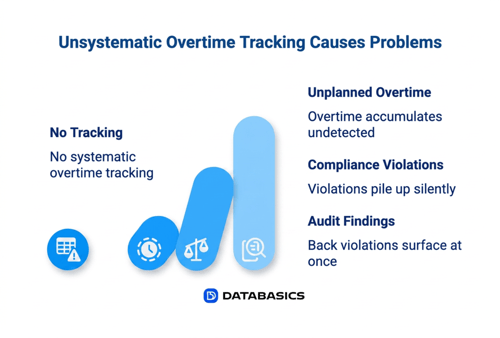
The problem chain is predictable. No real-time visibility means unplanned overtime accumulates undetected. Compliance violations pile up silently. Then an auditor requests records, and six months of back violations surface all at once.
DOL audits focused on wage and hour violations have increased 40% since 2022 (DOL Enforcement Data). Wage and hour violations are the Department of Labor's most frequent audit finding (SHRM). The question for most mid-market companies is not whether they have exposure. It is whether they will discover it themselves or have it discovered for them.
Four Operational Failures That Drive Uncontrolled Overtime
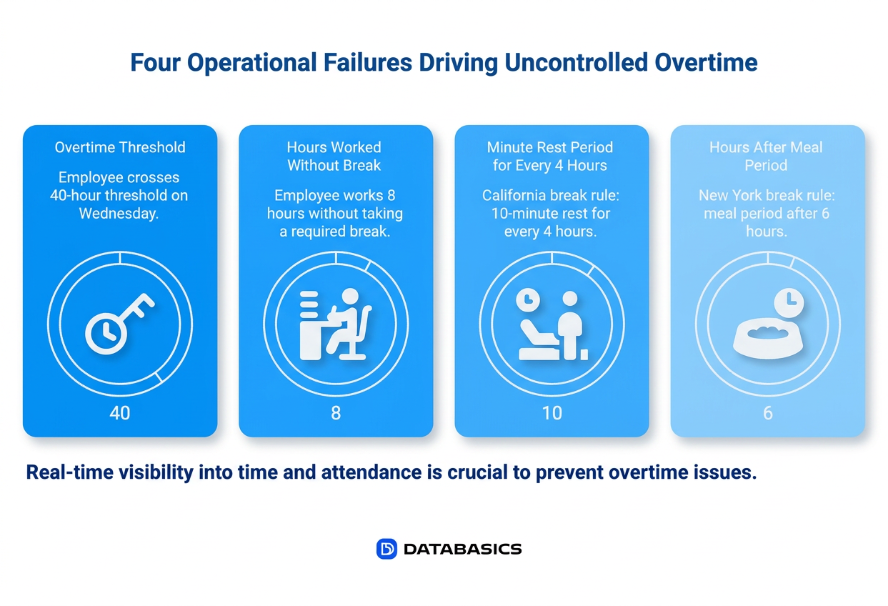 Overtime is a symptom. These are the root causes, and each one is preventable with real-time visibility.
1. Overtime that accumulates without anyone noticing
When scheduling, timesheets, and payroll live in separate systems, nobody has a real-time view of hours worked. An employee crosses the 40-hour threshold on Wednesday, but the manager does not find out until Friday's timesheet review. By then, the hours are worked. The overtime is owed. If the overtime was unauthorized, that is a compliance problem on top of a cost problem.
DATABASICS Time and Leave Management calculates overtime status the moment an employee clocks in. When someone approaches the overtime threshold, the manager gets an alert before the line is crossed. The manager can reassign work or approve the overtime deliberately. Either way, there is a decision and a record, not a surprise.
2. Late arrivals that trigger unplanned shift coverage
An employee does not show up for a shift. The manager scrambles and calls in whoever answers the phone. That person was already scheduled later in the week, so now they are headed toward overtime. This happens dozens of times per month in organizations with distributed teams or field workers. Each instance is unplanned, unbudgeted, and invisible until payroll processing.
DATABASICS shows managers who is clocked in and who has not arrived, instantly. The system also knows which employees are cross-trained for backup roles, so the manager can reassign a trained backup instead of defaulting to overtime for whoever is available.
3. Missed breaks that cascade into wage violations
An employee works 8 hours without taking a required break. In California, New York, and other high-regulation states, that is not just a policy issue. It triggers a wage violation: the company owes the break time plus a break premium, often equal to one hour of pay at the regular rate. That compounds into additional overtime liability. When break violations go undetected across multiple employees for months, the back pay can reach six figures before penalties are even calculated.
DATABASICS enforces break rules automatically. The system prompts employees to take breaks based on state-specific requirements (California: 10-minute rest period for every 4 hours worked; New York: meal period after 6 hours). Managers get notified when an employee approaches a break deadline without taking one. Every break is logged and attached to the timesheet for audit defensibility.
4. Remote and distributed schedule blindness
Remote teams and PTO coverage make it easy to lose sight of total hours. One employee takes PTO, another covers, a third picks up overflow. Nobody has a clear view of the aggregate, so unplanned overtime gets buried in the schedule.
DATABASICS consolidates all time data regardless of location. Remote employees clock in from the app. Managers see actual hours, PTO balances, and scheduled coverage in one view. Proactive scheduling prevents overtime surprises before they happen.
The Shift from Reactive Payroll to Proactive Control
Overtime is often framed as a labor problem. The instinct is to say "we need to hire more people" or "we need to reduce hours." Neither of those responses addresses the actual issue.
The actual issue is visibility. When you move from reactive payroll (discovering violations after the fact) to proactive time management (preventing violations before they happen), the economics change:
Compliance risk drops because violations are prevented, not discovered during audits. Scheduling efficiency improves because late arrivals and coverage gaps are managed in real time, not reconstructed from memory at the end of the week. Break compliance becomes automatic, not something that gets audited three years after the fact. Remote visibility becomes centralized, not scattered across locations and apps. And administrative overhead shrinks because automation scales with transaction volume, not headcount. Forrester estimates real-time tracking saves approximately 192 hours annually on month-end close processes alone (Forrester, 2025).
The CFOs getting the most from their overtime programs are the ones who stopped treating overtime as a scheduling problem and started treating it as a financial control problem.
Control starts with visibility. That is what real-time time and leave management delivers.
What the Numbers Say
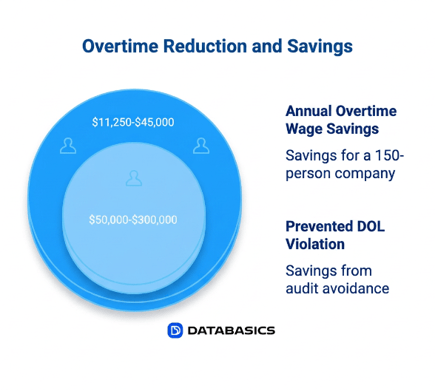 Industry benchmarks suggest companies that move from manual tracking to real-time scheduling and approval workflows typically see a 15-30% reduction in unplanned overtime (ADP, 2023).
For a 150-person mid-market company, that translates to $11,250-$45,000 in annual overtime wage savings. Add audit avoidance (one prevented DOL violation saves $50,000-$300,000 in penalties and legal fees) and administrative time savings, and the ROI payback period is typically 6-12 months through overtime reduction alone.
Labor spend represents 25-40% of mid-market operating costs (SHRM, 2024). Overtime visibility is not a nice-to-have. It is one of the highest-leverage financial controls available.
Frequently Asked Questions About Overtime Compliance
What is the typical penalty for overtime violations in a DOL audit?
Penalties from a single DOL wage audit typically exceed $200,000 when combining back pay, civil penalties, and legal fees (DOL Wage and Hour Division). The amount depends on the number of employees affected, the duration of the violations, and whether the violations were willful.
Do salaried employees create overtime compliance risk?
Yes. Misclassification of exempt versus non-exempt employees is a leading DOL finding. Many roles classified as "exempt" do not actually meet FLSA exemption tests and are legally owed overtime. Hybrid workforces with a mix of hourly and salaried employees create tracking blind spots that audits expose.
Can scheduling software prevent overtime if labor demand is unpredictable?
Scheduling software cannot eliminate all overtime. But most unplanned overtime is not caused by unpredictable demand. It is caused by poor scheduling, understaffing, or calling in overtime as a default. Real-time visibility lets managers make faster decisions when demand spikes: reassign work, reduce scope, call in cross-trained staff. The goal is not zero overtime. The goal is authorized, budgeted, defensible overtime versus unauthorized, untracked overtime that becomes a compliance liability.
What is the difference between reactive payroll and proactive time management?
Reactive payroll means discovering overtime violations after hours are worked and processed. Back pay is already owed and there is no way to undo the violation. Proactive time management means the system flags overtime thresholds, break deadlines, and policy violations in real time, before they occur. Managers receive alerts and can take action before a violation happens.
Next Step
If your organization manages time through spreadsheets or outdated systems, you have compliance exposure you cannot currently see. Book a demo to see how DATABASICS Time and Leave Management prevents the operational failures that drive uncontrolled overtime costs and audit liability.
Your Overtime Isn’t Costing What You Think It Is
The real risk isn’t the wage — it’s what you don’t see
Visible OT
Audit Risk
- After-the-fact fixes
- Manual work
- Audit risk
- Real-time alerts
- Automated compliance
- Controlled OT
DATABASICS delivers time tracking, leave management, scheduling, and expense reporting solutions for mid-market organizations. Founded in 1999, DATABASICS serves hundreds of customers across healthcare, nonprofits, construction, government contracting, and professional services. Learn more at data-basics.com.

Best DCAA timesheet software for government contractors (2026)
Read Now
Expense Reporting Compliance: Policy to Audit Trail
Read Now
From Timesheet to Audit Trail: Building Compliance Into Time Reporting
Read Now
Dynamics GP to Business Central Migration: What Happens to Your Timesheets and...
Read Now
Unify Timesheets and Expenses to Speed Project Billing
Read Now
Evaluating NetSuite? Five Timesheet and Expense Reporting Questions to Ask...
Read Now