UPDATED SEPTEMBER 2026 Government contractor timekeeping is not simply the act of collecting employee hours. The records may also support project accounting, payroll, billing, labor distribution, and Government review. A weak process at the point of entry can therefore create problems far beyond the timesheet.
The phrase "DCAA-compliant timekeeping" is often used to describe software, but the Defense Contract Audit Agency does not certify commercial products. Audit readiness depends on the contractor's requirements, written procedures, system configuration, employee behavior, supervision, accounting processes, and retained evidence.
The most useful way to evaluate government contractor timekeeping is to look at the controls operating from the employee's first entry through final reconciliation.
DCAA Time Tracking Buyer Guide
Know what evidence to request before choosing a system
Compare entry controls, correction history, approval workflows, charge-code restrictions, and labor reconciliation without relying on a compliance label.
Review the buyer guide →What government contractor timekeeping is designed to protect
The requirements that apply to a contractor depend on its agreements and circumstances. For covered defense contracts, DFARS 252.242-7006 includes criteria for identifying employee labor by intermediate or final cost objectives, charging direct and indirect labor to appropriate cost objectives, documenting adjusting entries, reconciling cost records, and reconciling billings with cost accounts.
DCAA's labor floor-check programs focus on whether timekeeping controls and procedures are operating and whether employee labor records are reliable. Depending on the review, auditors may observe or interview employees, compare recorded labor with the work being performed, examine charge numbers and classifications, and trace labor information into related accounting records.
That is why a strong process must connect people, policy, software, and accounting. The following eight controls provide a practical framework.
1. Written procedures employees can follow
A contractor should document how time is recorded, corrected, reviewed, approved, distributed, and retained. Procedures should identify the responsibilities of employees, supervisors, finance, payroll, project owners, and system administrators.
DCAA's Information for Contractors recommends detailed timekeeping instructions addressing daily entry, project or contract coding, changes, all hours worked, employee certification, and supervisor approval. The procedures should also explain what employees must do when a valid charge code is missing or when they cannot access the normal system.
Written policy alone is not enough. Employees need training when they join, when procedures change, and when new contracts or charge structures affect their work. Training records can help demonstrate that the organization communicated its process consistently.
2. Timely entry by the employee who performed the work
 DCAA guidance recommends that employees record their time daily. It also places responsibility for accurate and complete preparation on the employee and calls for employees to certify their hours and cost objectives at the end of the work period.
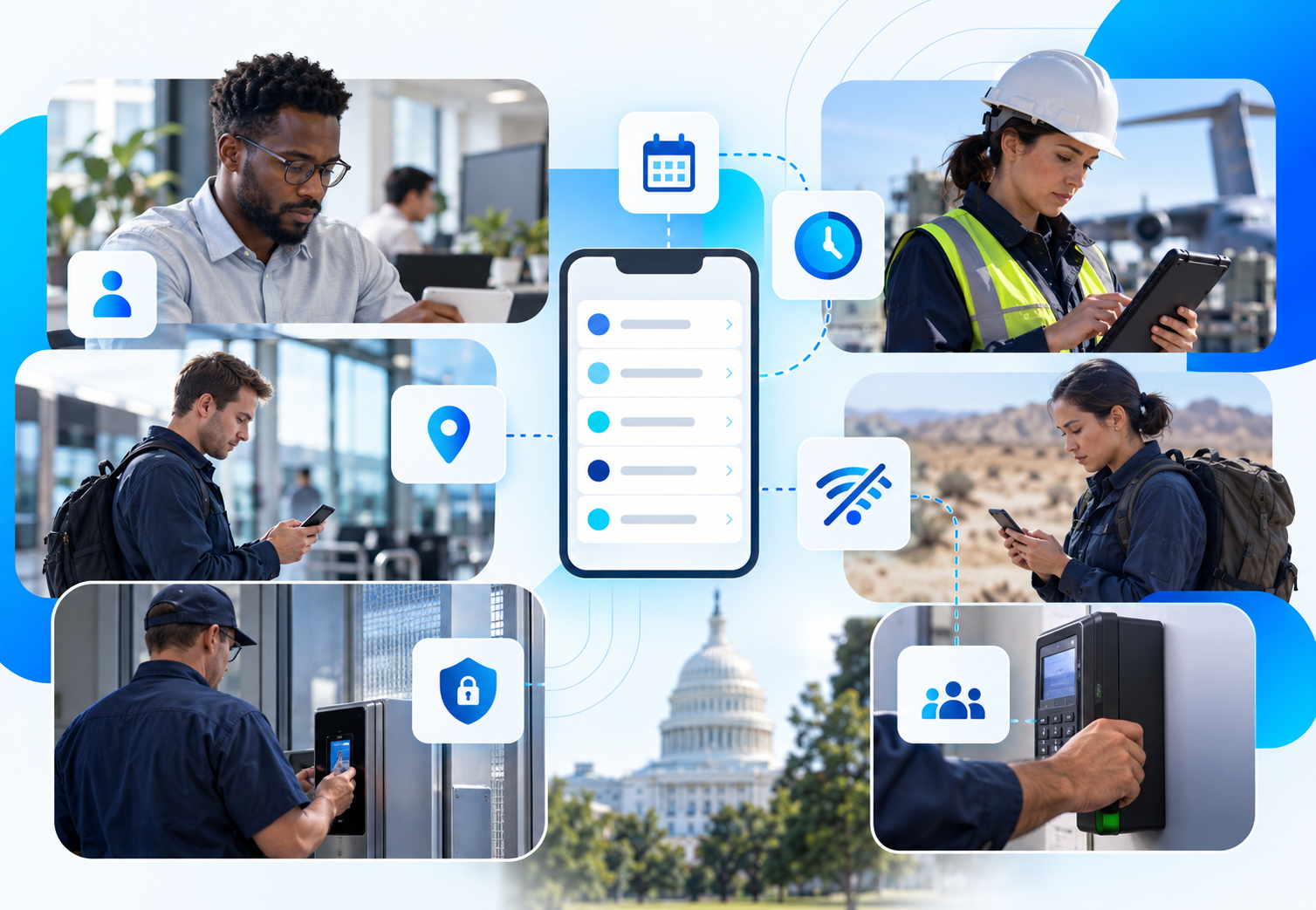
The system and policy should make it practical to comply. Consider how time will be recorded by:
- Office-based employees using project timesheets
- Hourly employees clocking in and out
- Remote and traveling employees using mobile devices
- Employees working temporarily without connectivity
- Workers using a shared clock
- Employees in secure environments where personal devices may be restricted
Different entry methods should not produce different accountability. Each method should preserve the employee identity, timing, project or cost objective, corrections, and approval path needed by the contractor.
3. Authorized project and charge-code selection
Employees should not have to guess where their time belongs. DCAA's contractor guidance recommends giving employees current project numbers and descriptions so they can distribute time accurately.
A controlled system can help by limiting available selections according to the employee, project, contract, role, labor category, and effective date. It can also prevent new charges to closed work and require the dimensions needed for payroll, project accounting, billing, or the general ledger.
The contractor still owns the charge structure. Project and accounting teams must create accurate codes, authorize the right employees, communicate changes, and monitor indirect or exception accounts.
4. Corrections that preserve the original record
An error does not automatically make a timekeeping process unreliable. An unexplained or overwritten correction does.
DCAA guidance recommends procedures that identify the original charge, the corrected charge, and employee concurrence with a change. A useful audit history should show:
- The original and corrected values
- The person who made the change
- The date and time of the change
- The reason or explanation
- Whether the record had already been submitted or approved
- Any rejection, resubmission, or reapproval
Contractors should define who may make corrections, when proxy entry is permitted, and which explanations are required. Supervisory or administrative access should not make changes invisible.
DCAA Compliance Guide

Review the broader DCAA control environment
Timekeeping is one part of a larger process involving labor distribution, cost allocation, expense reporting, approvals, and retained evidence. Download the DATABASICS guide for a broader look at these connected responsibilities.
Download the DCAA compliance guide →5. Supervisor review and separation of duties
 Supervisor approval adds review, but only when roles and exceptions are controlled. Employees should not approve their own time under the standard workflow. Contractors should also determine who may reopen an approved period, change an entry on someone else's behalf, approve project charges, or export final records.
DCAA guidance generally places timesheet preparation with the employee and calls for supervisor review. It describes limited circumstances in which a supervisor may prepare a record for an absent employee and recommends employee follow-up after the employee returns.
A contractor's workflow should preserve approvals, rejections, delegations, corrections, and resubmissions. Temporary approval authority should have a defined start, end, and scope.
6. Labor distribution and accounting reconciliation
Timekeeping does not stop when a manager approves a timesheet. Approved labor must reach payroll, project accounting, billing, and the general ledger with enough detail to remain traceable.
Finance should be able to test whether:
- Approved hours agree with payroll records
- Direct and indirect labor reaches the correct cost objectives
- Labor-distribution records trace back to employee time
- Project and job-cost records reconcile with subsidiary and general-ledger records
- Billing records reconcile with accumulated costs
- Adjustments and integration errors are documented and resolved
When reviewing ERP and accounting integrations, ask what data moves, which system owns each field, how often records transfer, what happens when a transaction fails, and whether corrections remain traceable across both systems.
7. Controlled access, reporting, and retention
Access should reflect job responsibility. Employees, supervisors, finance reviewers, project managers, payroll staff, and administrators may need different abilities to view, enter, approve, change, reopen, or export records.
Contractors should review privileged access periodically and preserve administrative actions in the audit history. Useful monitoring reports include missing or late time, correction activity, reopened periods, unused or invalid charge codes, approval delays, and labor-distribution exceptions.
Retention should be based on the applicable record category, contract clauses, timing, and other legal requirements. FAR Subpart 4.7 contains different periods for labor-distribution, time-and-attendance, payroll, and other records. Contractors should obtain legal or compliance guidance rather than applying one universal number to every record.
8. Routine internal testing
Audit readiness is easier to maintain when the contractor tests its own process. A periodic spot check can select an employee and trace one work period through:
- Work assignment and authorized charge codes
- Employee entry and certification
- Any corrections or explanations
- Supervisor approval
- Labor distribution
- Payroll, project accounting, billing, and general-ledger records
Include remote, mobile, offline, and shared-clock users in the sample. Test whether employees can explain their timekeeping procedures and whether the records support what they say.
For a focused audit-preparation process, review how to prepare for a DCAA timesheet audit. For a reusable control review, use the DCAA timekeeping evaluation checklist.
How DATABASICS supports government contractor timekeeping
DATABASICS time tracking can be configured to support same-day entry rules, required explanations for late entries and corrections, traceable revision history, configurable approvals, project and labor-category controls, role-based access, reporting, and downstream labor reconciliation.
These capabilities support a contractor's control environment. They do not replace the contractor's responsibility to interpret its agreements, define procedures, configure the platform, train employees, monitor exceptions, and retain the appropriate evidence.
DATABASICS retains customer records for seven years by default. Contractors should still confirm the retention periods that apply to their own records and contracts.
Government contractors can review the broader DATABASICS approach to timekeeping and expense management for government contracts.
Request a compliance-focused walkthrough →
Frequently asked questions
What is DCAA-oriented timekeeping?
It is a timekeeping process designed to support applicable government-contract requirements through documented procedures, accurate employee entry, appropriate cost-objective coding, traceable corrections, supervisor review, labor distribution, reconciliation, access control, and retained evidence.
Does DCAA certify timekeeping software?
No. DCAA evaluates contractor systems, procedures, records, and submissions based on applicable requirements. A software product can support necessary controls, but it does not independently make the contractor compliant.
Should government contractor employees enter time daily?
DCAA's Information for Contractors recommends daily employee time entry. The contractor should document the applicable procedure and provide a workable process for office, remote, mobile, offline, and secure-facility employees.
What should happen when an employee corrects time?
The process should preserve the original and corrected values, identify who made the change and when, document the reason, and capture employee concurrence when required by the contractor's procedures.
Why does labor reconciliation matter?
Approved time must remain consistent with labor distribution, payroll, project accounting, billing, and general-ledger records. Reconciliation helps identify mapping problems, mischarges, incomplete transfers, and unexplained adjustments.